
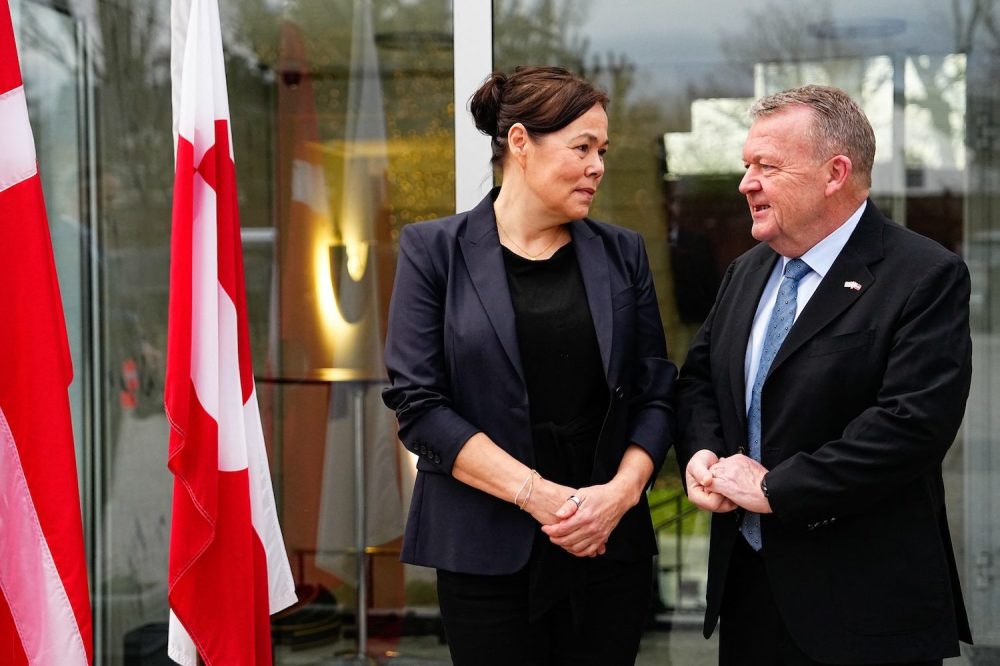
The Danish foreign minister fist-bumped his ambassador and then rushed up to Greenland’s foreign minister and lit her cigarette. They had just met with U.S. Vice President J.D. Vance and U.S. Secretary of State Marco Rubio. In the Jan. 14 meeting, they discussed U.S. President Donald Trump’s desire to “own” Greenland, the Greenlandic people’s firm opposition to being owned, and how they can all move forward in light of this impasse.
As the smoke settled between the high-level diplomats outside the embassy’s car, a new view was settling in across the Atlantic Ocean. Whatever happens next, Denmark, and its relationship with the United States, has changed irreversibly.
The Danish foreign minister fist-bumped his ambassador and then rushed up to Greenland’s foreign minister and lit her cigarette. They had just met with U.S. Vice President J.D. Vance and U.S. Secretary of State Marco Rubio. In the Jan. 14 meeting, they discussed U.S. President Donald Trump’s desire to “own” Greenland, the Greenlandic people’s firm opposition to being owned, and how they can all move forward in light of this impasse.
As the smoke settled between the high-level diplomats outside the embassy’s car, a new view was settling in across the Atlantic Ocean. Whatever happens next, Denmark, and its relationship with the United States, has changed irreversibly.
“We put all our eggs in the United States’ basket. We’re ‘super-Atlanticists.’ We’ve gone far further in our support of the U.S. than many other nations. We’ve really prioritized the relationship to the U.S., but it will never be the same again,” said Mikkel Runge Olesen, a senior researcher at the Danish Institute for International Studies.
“The most trans-Atlantic politicians are the most bitter and skeptical. [Danish Prime Minister] Mette Frederiksen and [former NATO Secretary-General] Anders Fogh Rasmussen, for example,” Olesen said. “I think, from a Danish perspective, the idea of the USA as our security strategy is gone. Now we’re looking for a European alternative. It’s been an expensive lesson. We trusted the Americans, and we never should have done that.”
The Jan. 14 meeting did nothing to assuage Danish opinion. Trump has not curbed his enthusiasm for owning Greenland—or “conquering” it, as Danish Foreign Minister Lars Lokke Rasmussen put it at a press conference after the meeting. According to Rasmussen, there is still deep disagreement on the issue, but the three parties agreed on creating a high-level working group.
Immediately after the meeting, the European Parliament issued a strongly worded statement in support of Denmark and Greenland. But something has changed in Europe. It’s no longer just strong statements—several nations are now committing to boots on the ice.
France, Germany, the Netherlands, the United Kingdom, Norway, Sweden, Finland, and Estonia have all responded to a European military exercise in Greenland and are sending troops there. In addition to opening a permanent French Consulate in Nuuk in early February, French President Emmanuel Macron has said that more military is on its way to the Arctic. “An initial team of French soldiers is already on site and will be reinforced in the coming days by land, air, and sea assets,” he said in an address to the French armed forces on Jan. 15.
Even if it’s just a few officers, the message is a strong one. “Imagine a U.S. helicopter lands in Greenland, what do they see when they step out? Nobody? A dogsled? Or a row of European soldiers? It makes a big difference,” said Christine Nissen, a chief analyst at Think Tank Europa. “By raising the stakes, Denmark makes it more difficult to go a different path than diplomacy.”
For Nissen, this is part of a more seismic shift in European thinking.
“Yesterday’s world has suited Europe really well,” Nissen said. “We’ve set everything up around it. Our entire society is based in a free world, international trade. We can import both security and energy and small cheap thingamabobs from China and not have to do anything ourselves to keep the model we have. This is a goodbye to all that. It takes time to react to, that’s why there’s been this paralysis.”
The result is likely to be a deepening of European unity. After Russia, the United States is now the second major power to pose a threat to European territory. This creates a reason for both anti-Russian and anti-American segments of European opinion to come together and argue for a stronger Europe.
“What we’re seeing right now is everyone moving closer together in the European Union,” said Marlene Wind, a professor and director at the Center for European Politics at the University of Copenhagen. “A united Europe is not what Trump wants. He wants a divided Europe. So, this is a bit of an own goal.”
“We’ve learnt that we shouldn’t venture into U.S. dependency again, because what if there’s a new Trump down the line?” Wind said. “We’re not going to have our IT infrastructure, weapons, and security tied up to a character who so very clearly hates the EU and Europe.”
The calls for strategic autonomy are now coming from all sides. A week ago, German Brig. Gen. Frank Pieper responded to Washington’s raid on Venezuela by posting online, “Germany and Europe can no longer reliably base their existence on the USA and its nuclear umbrella. CONCLUSION: Germany needs its own nuclear weapons.”
Of course, Europe can’t just stop relying on the United States overnight. Pilots are trained to fly Lockheed Martin planes. Palantir supplies Europe with surveillance technology. Joint NATO exercises require systems that work together, meaning U.S. systems. In other words, Europe is already in the U.S. military industrial complex and getting out requires a lot more than switching from Apple to Nokia.
But that doesn’t mean Europe isn’t going to do its best. “This fall, Denmark made its largest miliary expenditure ever, 58 billion kroner [$9 billion] on a new ground-based air defense system,” Nissen said. “They chose a European solution. We haven’t had an air defense system since 2004, so there was no lock-in effect like with the F-35s. So, when we buy something new that isn’t American, it’s also a declaration for the future, that we’re locking in on European solutions.”
Europe’s transition is not going to be easy. But the continent’s leaders now believe it is necessary. For Nissen, “it’s a path of opposites. On the one side, there’s the structural connection and the great difficulty it would be to sever that, but on the other side, you have to do it. Because it’s not a long-term solution not to.”
The glacial decoupling from the U.S. defense industry is going to hurt the United States, Nissen said. European countries have increased their defense spending the last few years. Russia’s invasion of Ukraine and Trump’s continued threats of punishing nations not living up to NATO’s required spending helped that. Most of that money has gone straight to U.S. arms suppliers. According to the Stockholm International Peace Research Institute, “For the first time in two decades, the largest share of US arms exports in 2020–24 went to Europe.” This means, Nissen said, that “there will be a lot of angry lobbyists from the defense industry if Europe stops the imports.”
While Europe prepares for a long-term shift in its relationship with Washington, its leaders are still trying to smooth over tensions.
Trump has provided many contradictory and incoherent reasons for wanting Greenland. In his meeting with Rubio, Rasmussen tried to address the most recent one: Trump’s supposed fear of Russia or China taking over the island. At a subsequent press conference, Rasmussen said that he and his colleagues highlighted Denmark’s investments in Arctic defense, explained that the United States could invest and base forces in Greenland, and noted that the United States has actually decreased the number of troops present on the island over the years. He had also pointed out that a Chinese warship hasn’t been spotted around Greenland a decade.
Speaking with Danish reporters after the conference, Rasmussen offered one additional point. Trump, he said, previously wanted to own the Panama Canal but now seems to have dropped that obsession. If Europe can keep him occupied long enough, Rasmussen suggested, then perhaps he will also forget about Greenland.
The change in Europe is real. After all, European forces are still on the way to Greenland. But it seems European leaders haven’t completely given up on the strategy of hoping and waiting either.

