
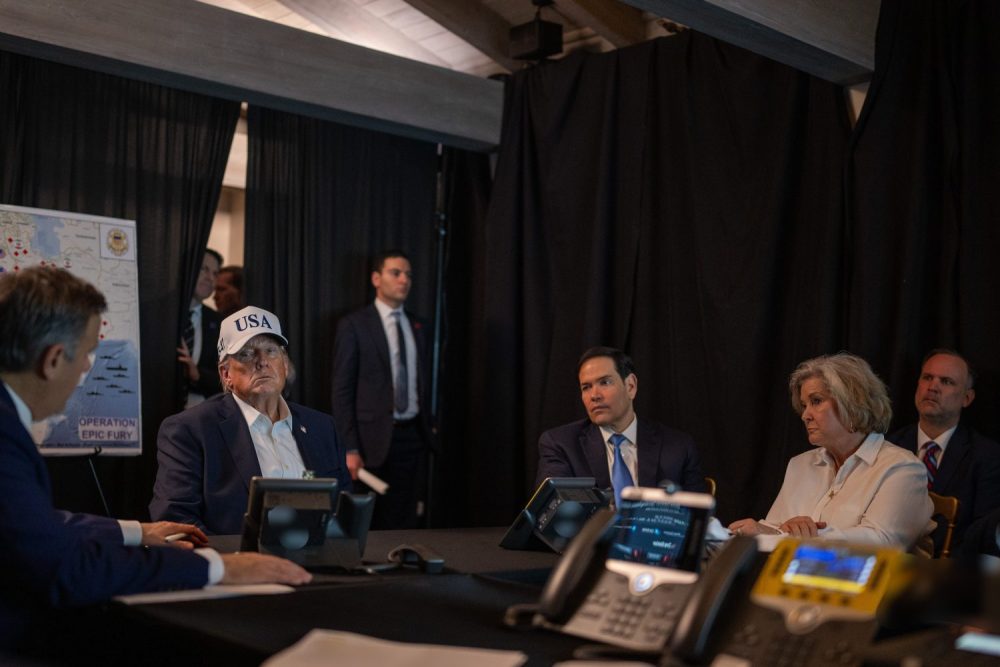
Intense fighting is underway in the Middle East. Early on Feb. 28, Israel and the United States struck a range of sites across Iran. It later emerged that Ayatollah Ali Khamenei, Iran’s supreme leader, was killed as bombs rained down on his compound. But both before and after the confirmation of that news, Tehran shot volleys of missiles at Israel, suggesting a command-and-control structure that operates even in the top leadership’s absence. Iran is also attacking several other countries in the region, particularly Gulf states that host U.S. military bases such as Qatar, the United Arab Emirates, Saudi Arabia, and Kuwait.
How will the war end? How do each of Iran, Israel, and the United States define success, and how different are their respective thresholds for pain? On the latest episode of FP Live, I spoke with Vali Nasr, an expert on Iran and the Middle East, a former senior advisor in the U.S. State Department, and a professor at Johns Hopkins University. Subscribers can watch the full discussion on the video box atop this page or download the free FP Live podcast. What follows here is a lightly edited and condensed transcript.
Ravi Agrawal: Ali Khamenei was a brutal leader. At 86 years old, he had ruled Iran for more than three decades. Vali, how are you processing his death?
Vali Nasr: In some ways, it was expected, not just because of his advanced age but because taking him out was one of the war goals of both Israel and the United States. It’s momentous for Iran and the Middle East. This is a leader who was in charge of Iran for 36 years and also was the main focus of the Iranian strategy to confront the United States and resist anti-imperialism in the region. So, his passing is a turning point for Iran.
RA: But it’s clear that Iran is not Venezuela, where Nicolás Maduro was replaced by a deputy in a one-day mission. Iran is continuing to retaliate despite Khamenei’s death. Who is in charge right now?
VN: Iran’s Islamic Republic has been designed to survive. This goes back to the early years of the republic, when there were assassinations of its president, prime minister, and senior leaders, and continued through the Iran-Iraq War and even the 12-day war with Israel. So, this system is built not to rely on one person. Even though Khamenei was the most significant leader in Iran, who set the course for the country and made the final decisions on things like the nuclear deal, Iran is operationally a multi-nodal system. There are different institutions and different operational leaders. As we can see, even the removal of Khamenei so early in the war has not impacted Iran’s footing. It’s executing a plan and going forward.
He created a system in which there are key leaders, like national security advisor Ali Larijani, the speaker of the parliament Mohammad Bagher Ghalibaf, the head of the judiciary, commanders of the Islamic Revolutionary Guard Corps, and several layers below them. There’s also the operational side of the state under the presidency, which constitutes what I would call Iran’s deep state of senior statesmen, bureaucrats, military commanders, and clerics. That deep state and the institutions they control are collectively managing the war.
RA: Who might eventually succeed Khamenei? Is that even important in the here and now as we look at these continuing attacks?
VN: We don’t know. I don’t think Iran will name a leader immediately, largely because they have in their rear-view mirror what happened to Hassan Nasrallah’s immediate successor. Israel killed Nasrallah of Hezbollah and then killed his immediate successor, as well. They are moving in the direction of appointing a successor, but we may not see it right away. Those moves are largely to signal continuity to the world, the Iranian population, and Iran’s followers in the region that the system will continue in accordance with the constitution. There will be a supreme leader. But, in reality, it will take some time for that person to actually assert control and consolidate power.
RA: So when you hear the likes of U.S. President Donald Trump or Israeli Prime Minister Benjamin Netanyahu encouraging Iranian people to protest, given what you’re describing about the deep state in Iran, what is the likelihood of an uprising?
VN: Well, the anger that the people felt, which led to the uprising in January, is real. And there is still a lot of anger and sorrow regarding the bloody way in which the system cracked down to suppress those demonstrations.
But there are a few things going against an uprising right now. First of all, despite the anger, there is no political movement on the ground outside of the Islamic Republic to organize and direct political sentiment and anger in a sustained, resilient way toward the goal. And a leadership-in-exile cannot provide that and doesn’t have the ground game to manage it. Secondly, there is a very heavy presence of security forces, particularly in the capital city, to discourage demonstrations in the streets. And thirdly, the Iranians are facing a war. They’re worried about their own security. And they’re also worried about how the war will end and whether they would lose their livelihoods.
When the dust settles, when there is no war, that’s when we might see political expression.
RA: Vali, you’ve worked in the U.S. government. What are you able to discern right now about the White House’s objectives? What does it want to achieve? And at what point are you imagining that it concludes that the job is done?
VN: It’s very difficult to tell because the president never really made a case for this war. It looked like he was very satisfied that, in June, the United States destroyed Iran’s nuclear program. There was no reason for him to talk to the Iranians. And then he suddenly became interested in military intervention to bring about regime change in Iran. So, America’s objective went from Iran’s nuclear program to regime change. And then when that moment passed, with the suppression of the protests, he went back to using the nuclear deal as an argument. And then he started the war and is again asking for regime change in Iran. So, it’s not clear why the United States felt this urgency to go to war with Iran. Now that the war has started and the supreme leader has been killed, I think the president is ready to call victory. It’s the Iranians who don’t want to stop right now, largely because they think there’s any gain in a quick cease-fire. And that puts the president in a pickle as he’s now caught in an expanding war, which is raising energy prices, and could expand even further in terms of U.S. casualties and damage to U.S. assets.
RA: So you’re saying this war ends, to some degree, when Iran wants it to end. I have to ask, how long can Tehran keep this up?
VN: Well, I would just caveat what you said in that it’s up to Iran and Israel, because I think Israel would like this war to go on longer until it’s achieved its war goals, which, in Israel’s case, are much clearer. In other words, Israel wants to topple the Islamic Republic or at least degrade it to a point that it is no longer a real regional actor—and also to degrade Iran’s missile and other military capabilities to the point that they’re no longer a threat to Israel. Israel believes that it has to bomb Iran for a much longer period of time in order to get close to that goal if not achieving it.
Iran also thinks that a short war in which the United States does not pay much of a price would only lead Trump to think that war with Iran is easy. And he can go back to it. But if the war went on longer, got bloodier, more complicated, then it would establish a deterrence against further American aggression against Iran down the road—a kind of deterrence that Iran did not establish after the June war. The Iranians think right now that they have the stamina to keep hitting targets in the Gulf, raise energy prices, raise concern in global markets, and also gradually bring the Europeans into it. Shutting down liquefied natural gas terminals in Qatar ultimately impacts Europe’s energy supplies. And all of this essentially makes the war more and more complicated, to the point where the United States may decide that it has to pay a higher price for a cease-fire rather than just demand it at this point in time.
RA: It feels that when Iran was striking back during the 12-day war last year, it was holding back. It wasn’t using its full capacity. It was picking targets that it was telegraphing ahead of time and wasn’t looking to cause maximum damage. That’s my assessment. Right now, it is clearly escalating beyond what it did last summer. Do you know how much more capacity it has? How many more cards does it have to play under these circumstances? How bad can it get?
VN: I agree. Iran is escalating gradually in this war, whereas the biggest punch from Israel and the United States came right at the beginning—killing the supreme leader and 30 or 40 other commanders, devastating military bases, etc.
First of all, Iran is trying to deplete the supply of Patriot missiles, interceptors, and THAAD missiles, across not only Israel, but the region. In other words, every little Iranian drone that might cost $10,000 or $20,000 requires a large amount of Patriots and other interceptors to bring it down. Ultimately, they calculate that at some point this will become an issue for Gulf countries, the Pentagon, and Israel. That is one of the games they’re playing.
Secondly, they’re not trying to necessarily hit targets in the Gulf or in Israel but to keep constant pressure. They are sending missiles to Israel throughout the day, not in large volumes, but in a continuous pattern and similarly in the Gulf. The goal is to keep constant pressure on the air defense systems and on the populations in those countries. If people have to continuously run to shelters, you can completely disrupt activities. And then, at some point, they’re going to go to higher-grade missiles and capabilities once the air defense systems have been depleted. So, I think we actually haven’t seen the worst of the war.
This war has now become a test of stamina: Who can knock out whom first? Do the Israelis and Americans break the back of the Islamic Revolutionary Guard Corps and hit enough missiles, silos, and launchers to incapacitate Iran’s missile capability? They clearly have not achieved that. Or can the Iranians stay in the game long enough to change the calculations in Washington and [Tel Aviv]? The Iranians are going to continue to escalate gradually and make this war more and more costly, both financially and in material terms for the Gulf and for Europeans.
RA: Can you give us an overview of what you’ve called the Axis of Resistance, Iran’s so-called proxy groups in the region? What is their capability right now, and at what point do you think they might enter the fray?
VN: The proxy with the greatest capability to have a material impact on this war is the Houthis, because their missile firepower is intact. They could target Israel or shipping in the Suez Canal and the Red Sea. They could also, in certain scenarios, end their cease-fire with the Gulf countries and start shooting at Saudi Arabia and the UAE from the rear side, as well as at American bases in the Gulf. Yes, the United States, Israel, and the Saudis can take them on, but that also means diverting certain attention to Yemen.
Similarly, Hezbollah is not in a position to really dent Israel, but it can create a sufficient amount of distraction to force Israel to focus on its northern border, either with air campaigns or by putting troops in Lebanon. So, the Iranian game is not that any one of these things will make a big difference for Israel and the United States, but that this combination—across a much larger battlefield than the United States and Israel had planned for—can change the calculations.
Israel and the United States have calculated fighting Iran along two corridors: offensively and defensively in the air corridor, and in the corridor between Iran and U.S. bases in the region. The Iranians are trying to expand this to civilian areas within the Gulf as well as the broader region. So, it benefits Iran to fight at a low boil across a broader region so they can stay in the fight for longer.
RA: It strikes me that the three main actors here—Iran, Israel, and the United States—each have a different pain tolerance of how much they’re able to sustain in terms of civilian losses, infrastructural damage, and military damage, before they might radically change their calculations. From what you’re describing, Iran seems to have a remarkably high pain threshold. They’ve lost their top leader, and they’re still holding back militarily with their proxies. How much more pain do you think they can take before any of these calculations change?
VN: Iran can take the pain. The question is when their capabilities may falter. They have made the decision that the only way the Islamic Republic, the revolution, and even the country survives is to persevere in this fight. In particular, this cycle of assassinations has convinced the leadership that any or all of them may be killed at any moment. So, they’re all in on this fight.
Israel also has a fairly high threshold of pain. It has now made it its mission to defeat Iran and its proxies, and it has the commitment and support of its population to do so—although one can see at what point that might change, because the difference is that, in Israel, you do have public opinion that the government may actually have to respond to. In Iran, you don’t, especially after the suppression in January.
The United States is the Achilles heel, particularly because Trump himself has been skittish about messy military entanglements His base doesn’t like this, and he hasn’t even made a case for war to his base or to the American public. He is the most likely to cringe at higher gas prices and substantial damage that would provide bad optics in the United States. It makes sense for the Iranians to put their thumb on that vulnerability, so it’s really a test for Trump.
Part of the danger here is that the Iranians don’t want to go back to where they were at the end of the June war. For the Iranians, this is the last battle. Either they will lose completely and fall, or they will be able to change the rules of the game going forward, which means that there will not be a war with the United States and Israel for some time to come. So, their calculations are very different from Trump’s.
RA: Given what you say, is it your sense that the White House has enough Iran advice? Are they properly gaming out the Iranian pain threshold?
VN: I don’t think so. When U.S. special envoy Steve Witkoff said that the president was frustrated that the Iranians hadn’t capitulated, it just meant that they completely misunderstand what the calculation is in Iran. I’m sure they are seeing battlefield evaluations that tell them that this is not going in the direction they thought and that the Iranians, despite the killing of Khamenei, are not ready to throw in the towel.
We may end up seeing this as a huge miscalculation on the part of Trump, based on a misreading of the adversary’s thinking.
RA: A lot of the Gulf countries—the UAE, Qatar, Saudi Arabia, Oman, and Bahrain—have been facing attacks from Iran. They’ve had civilian casualties and infrastructural damage. I recognize they are not a monolith, so they will have different reactions, but can you give us a broad sense of how might they be reacting?
VN: The Gulf countries face a massive dilemma, which is that they host U.S. bases in order to attack Iran or protect against Iranian attacks. But, in reality, these bases are not able to provide protection to the Gulf countries.
Iran has also decided that it’s going to go after them, not because of their support for the United States—although that’s the excuse—but because impacting the Gulf economies and energy supplies impacts the global economy. So, Iran is after creating pressure on Trump by disrupting and impacting the global economy. That means that you have to create some degree of risk for the Gulf and also disabuse the world of this notion that the economies of the Gulf can be purring, generating money, becoming a source of economic prosperity around the world, while being divorced from a war with Iran. By embroiling them, Iran is creating pressure on the entire global economy to its own advantage.
Now, the problem that Gulf countries have is if they join the U.S. fight—not that they will really change the military balance in any way—and the regime survives, then they’re at risk of an Iranian attack for decades. That will ruin their economies. If they don’t join and the regime survives, the risk from Iran doesn’t go away.
RA: Oman’s foreign minister, who was the chief mediator in these talks, flew to the United States last week and told the media that the talks were going better than the U.S. side had been saying in public. He said that Iran had essentially agreed to give up its nuclear program. Why did Oman come forward in that very public way to diverge from the U.S. version of events?
VN: I thought that was actually quite interesting and also worrisome because when he did that, my impression was that this was an act of desperation. This was a belief that Trump was not being appropriately briefed, or the entire United States was not getting a sense of what had been achieved in Geneva. This was the last act for him to come here and relay that achievement directly. He obviously had the support of his king, which suggests that Oman also decided that it was worth going against Trump by saying that the deal was achieved and it was being undermined.
RA: What kind of Middle East are you expecting to emerge in one, two, three, six months from now?
VN: For a while, the Middle East is going to be unstable, not just because of this war but because everything that has happened since Oct. 7, 2023, has disrupted the balance of power that was dominant in the region for about four decades. There are winners in that, and there are losers in that, but a new balance has not been achieved.
This war is part of establishing that balance—by finishing off Iran, by asserting Israel’s position in the region. So even after this war, also depending on how it ends, the Middle East is going to be negotiating a new equilibrium for a while. What worries me is that the U.S. administration is not thinking along these lines at all. It’s dealing with the region transactionally, without having any kind of a vision as to what the United States’ optimum equilibrium in the Middle East is and how to achieve it.

