

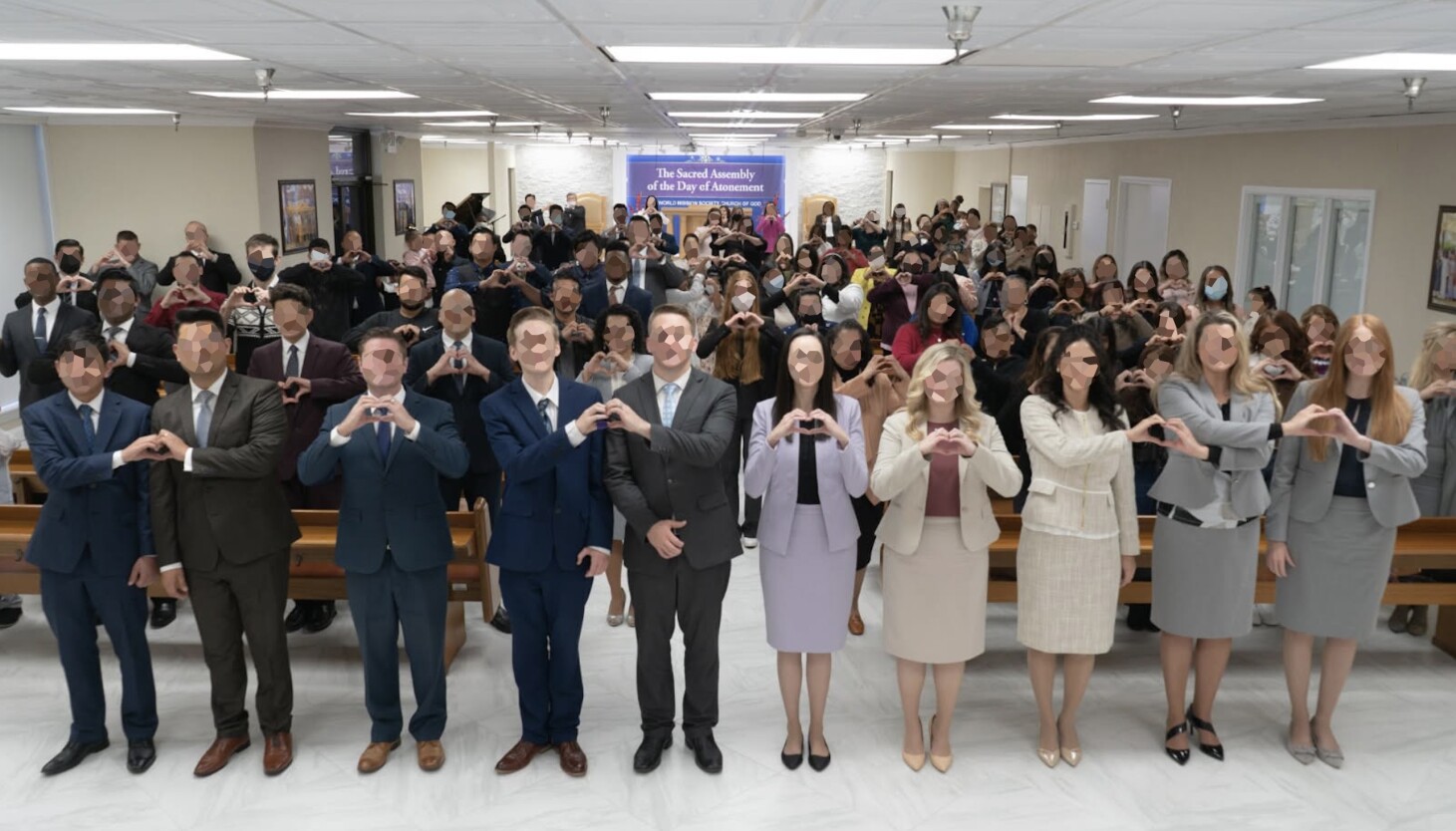
A religious organization described by some former members as a “doomsday cult” has been quietly expanding in the Chicago region in recent years, with at least four churches now in the suburbs, a site in the Loop and local charitable events such as blood drives that obscure the controversy dogging the group.
Called the World Mission Society Church of God, the organization was founded in South Korea in the 1960s and teaches that a Korean man who died in 1985 and was known as Christ Ahnsahnghong was the second coming of Jesus. A South Korean woman, Zahng Gil-jah, is also regarded as divine by the faith.
While the group identifies as Christian and publicly preaches love and volunteerism, court records and various ex-members portray it as a money-fueled operation that’s falsely predicted the end of the world, helped isolate members from non-believing friends and relatives, arranged marriages for congregants and at times pressured pregnant members to get abortions.
“I think they try to fulfill every stereotype of a cult,” says Adam Stillman, a resident of Utah who belonged to the group for a decade until 2024, when he and his wife quit after becoming disillusioned with the teachings and practices.
In a 2016 interview with NBC News, World Mission Society missionary John Power rejected similar accusations, which were gaining steam around that time on the East Coast, saying: “The word ‘cult’ to me, that’s very hurtful, this church and what I believe in is my choice.
“I’ve been here for 10 years, nobody is being controlled at all, people can come, they can go… if they label us a cult every religion has to be a cult. Where’s it going to end? If we’re brainwashing you because we show the bible, what about the Protestant church down the street? What about the Lutheran church down the street?”
“It’s almost like a form of racism, of discrimination,” Power said. “To me it’s just very upsetting… by saying our church is a cult, we are taking a step back from the progressive direction we’re heading as a country.”
The organization has also pushed back against critics in court, suing former member Michele Colon twice for defamation after she left the group and publicly criticized its practices.
Those cases were eventually dismissed, and Colon has litigation pending against the World Mission Society in which she accuses the group of, among other things, hacking her online and violating her free-speech rights by trying to silence her with its defamation lawsuits.
Among other things, Colon has portrayed the group as exploitative in seeking donations of time and money from members.
Power wouldn’t speak to the Chicago Sun-Times, but his group released a statement that said:
“Our local churches are composed of individuals who gather for worship, study and service within their communities. Participation is voluntary and reflects personal conviction developed through individual study and reflection.
“As with many religious organizations, there is a wide range of online commentary and opinion about the Church. While individuals are entitled to their views, allegations that have circulated over the years have been repeatedly examined and found to be unsupported by facts or outcomes. Such claims do not reflect the Church’s beliefs, practices or mission.
“Like all faith traditions, religious belief involves personal conscience and individual understanding. People may interpret or apply teachings differently, and the actions or statements of individuals, past or present, do not define or alter the Church’s doctrine.
“Rather than engaging in controversy, the Church remains focused on its core purpose: worship, spiritual education, and contributing positively to the communities it serves. Across regions, local congregations continue to engage in service-oriented activities that promote responsibility, compassion and community well-being.”
In Chicago area, World Mission Society grows
Officials with the organization wouldn’t answer questions about its size locally.
But what’s undeniable is that the group’s footprint has been expanding in the region and elsewhere — at times with help, even if unwitting, from mainstream denominations, the Sun-Times found.
In 2024, the Diocese of Buffalo — the arm of the Catholic church for part of New York state — sold its sprawling seminary complex to the World Mission Society for more than $4 million as the diocese was mired in bankruptcy proceedings brought on by clergy sexual abuse claims that have rocked the Catholic church across the country.
A spokesman for the diocese says the property was “sold to the highest bidder, as was required,” and that “given the diocese’s Chapter 11 status, these matters are governed by the Federal Bankruptcy Court.”
“We are aware of what some have alleged concerning the group. All of the sacramental aspects of the seminary were removed prior to the sale. The diocese has no further claim or prerogative with regard to the facilities or property.”

Locally, World Mission Society churches in Naperville and Oak Lawn were bought from evangelical Christian congregations, respectively, in 2010 and 2023, real estate records show.
Also within the last few years, the World Mission Society moved into a former Presbyterian church in Niles that, as with the site in Naperville, sits on a major thoroughfare providing high visibility.
Facing dwindling membership, the Presbyterian congregation in 2022 sold to a nearby business, which then sold at least part of the church property to the World Mission Society, according to records and interviews.
A historical timeline on the World Mission Society’s web site says that in 1999, as “the gospel began to spread to the United States, it soon reached Illinois, starting in a house church.”
Two years later, after “much prayer and preaching, the first generation of members were finally able to establish a building in Bloomingdale,” a western suburb.
That was on property purchased from the local fire protection district, records show.
By 2010, the church history says: “By God’s grace, members were found from all around the Chicagoland area.”

Two years later, an “office church” was established in the Loop, “home to university students, workers, and locals,” according to the group’s web site, nodding to the church’s evangelization efforts that appear to focus heavily on young adults, including military members and college students.
Another controversial organization — the Florida-based Church of Scientology — is also known to pursue young adults for recruitment. In 2024, it opened a site in a South Loop mid-rise next to a Columbia College Chicago dorm, and students there said Scientologists were almost immediately approaching them outside.

4 million members in 175 countries
Former member Mitch Cunico said there appears to be high turnover in membership, but aggressive proselytizing — including by approaching strangers in public places such as malls and campuses and going door to door — keeps filling the ranks.
“I’d say maybe two out of 100 people baptized will last,” says Cunico, a Colorado resident who identified himself as a leader for several years. “But those two” will “bring in numbers.”
“Nobody can top the WMSCOG on evangelism,” Cunico said, noting that it teaches salvation is dependent on “bringing people in and saving souls.”
The World Mission Society’s web site says the group now has nearly four million members in 175 countries and around 7,800 churches.
Another spiritual movement that started in South Korea and is considered unorthodox by mainstream religious standards, the late Sun Myung Moon’s Unification Church, has claimed 10 million members worldwide, with Moon regarded by his followers as a messiah who was known to preside over mass weddings.
Rick Alan Ross, an author who created the nonprofit Cult Education Institute and has helped families extricate loved ones from groups they regard as cults, says he and others use several main factors to determine whether a group is one.
If leaders are “an object of worship,” and groups enlist “coercive persuasion” to gain “undue influence” and then use that to exploit or do other harm to members, they fit the pattern of a cult, he says.
Referring to the World Mission Society Church of God, Ross says: “Not only are they a cult in my opinion, they’re a destructive cult.”
A number of former members and their families said the group at times portrays critics and non-believers as “unclean” and a negative force to be avoided, which they say helps explain why so many members become estranged from relatives and friends.

An out-of-state woman whose son is still a member of the group in the Chicago area said she hasn’t spoken to him in years, as he’s essentially cut her and other close family members off.
She blames the group, saying, “They were separating us, it was a very purposeful thing.”
Meantime, a divorce filing from a Chicago-area member’s now-former wife in Cook County Circuit Court said neither she nor “other family members or friends (outside other members of the church) are supportive” of the man’s “involvement and continued affiliation with this religious group,” which “upon information and belief is a religious cult.”
Several former members told a reporter their marriages were arranged by the church, which other ex-members say has been fairly common and is also asserted in a New Jersey lawsuit against the group.
The same suit, filed in 2017 by ex-leader Raymond Gonzalez, says the group is also known for “forcing or coercing World Mission members who get pregnant to have abortions.”
Another court document involving another former member says, “There are several accounts of members being encouraged, if not told, to undergo abortions because having children is counterproductive, it takes away from the imminent race to the end that is soon approaching.”
Abortion is often discouraged — and sometimes portrayed as a grave sin — by mainline Christian denominations.
Like other religious groups, the World Mission Society appears to be nonprofit and tax-exempt, filing a publicly available tax form with the IRS in 2009 covering the prior tax year for the Bloomingdale site.
That document noted there were three “voting members of the governing body,” with around $570,000 in “net assets or fund balances” at the start of the year and more than $870,000 at the end of the year.

The document also indicates the Bloomingdale church may have been involved in helping to pay for the construction of a new worship site in Texas. A web site for the group says it now has a presence in all 50 states.
The group’s charitable endeavors — from environmental cleanups to crime prevention events — often make it into local media reports without mention of the broader controversies.
In 2023, what appears to be submitted content by the World Mission Society was published by a suburban community newspaper touting the success of a blood drive in Naperville.
That same year, an arm of the group called the International WeLoveU Foundation participated in a “Mother’s Leadership Seminar” at a South Side public high school, according to a published account.
This past December, the same World Mission affiliate was part of a blood drive in Bolingbrook with the American Red Cross, an event covered by television news.
A Red Cross spokeswoman says: “Our work is guided by the Fundamental Principles of Neutrality and Impartiality, and we welcome individuals and organizations who wish to support blood donation, regardless of background or belief.”
“In this case, the WeLoveU Foundation served as a community host site, helping provide space and recruit donors with the sole focus of supporting patients in need.”

World Mission Society’s beliefs
World Mission Society teachings emphasize that humans originated in heaven but were cast to earth because of their sin, and that people now must follow God’s will as articulated by the bible and the group — with its belief in a “mother God” in Zahng Gil-jah — to attain salvation upon death.
The bible predicts an eventual apocalypse, and former members say the group has wrongly predicted the end of the world, including in 2012, which is why a number of critics refer to it as a “doomsday cult.”
Several ex-members say they were taught that someone’s position in life may be an indication of their heavenly sin, so homeless people are among those sometimes looked down on.
That topic was addressed in a 2024 court filing on behalf of a long-troubled man named Joshua Castellon after he pleaded guilty to, among other crimes, murdering two homeless people in Las Vegas in 2018.
Now in prison, Castellon had been a member of the World Mission Society, and the court filing from his lawyers said:
“While it cannot be said that WMSCOG directed Joshua to commit the instant offenses, it can be said that path to these offenses was paved by his relationship with WMSCOG. But it should also be noted that Joshua’s path even prior to WMSCOG was one filled with the instability that led him to WMSCOG.”
“There, he was consciously or not, taught to disdain the homeless.”
The group’s web site, however, mentions initiatives aimed at helping the un-housed.

Its statement to the Sun-Times says: “The Church does not comment on litigation, criminal matters or allegations involving specific individuals. Such matters are appropriately addressed through the legal process.”
A man named Ramon Ochoa Garcia appears to have been without a permanent residence, as court records say he was living in a van in 2024 when he was arrested for allegedly planting a small video recording device in several bathrooms at the Bloomingdale worship site.
He’s accused of recording two dozen victims in more than 40 videos “undressing in the restroom, and using the restroom, without consent . . . including a juvenile victim,” according to court records that say a World Mission Society pastor discovered the device and contacted police.
Like schoolteachers, religious leaders in Illinois are generally required under state law to report suspected sex crimes if they become aware of them and they involve minors.
Garcia’s case is pending in DuPage County Circuit Court.
Stillman, who was involved in a short-term mission in the Chicago region while still with the World Mission Society, said it’s common for ex-members to, out of disgust over their experiences, shun religion or God after leaving the group.
But he’s not among them, saying he’s since found a great deal of clarity and comfort in the Baptist tradition and adds, “I think religion can be good for people,” and “denying God or finding God should be on one’s own terms,” not solely “based on one group’s manipulation or deception.”
“I will always be open-minded,” Stillman says. “Who knows, maybe I’ll be Buddhist in 15 years… wherever the truth leads me and whatever I align with, that’s kind of my thing.”

