
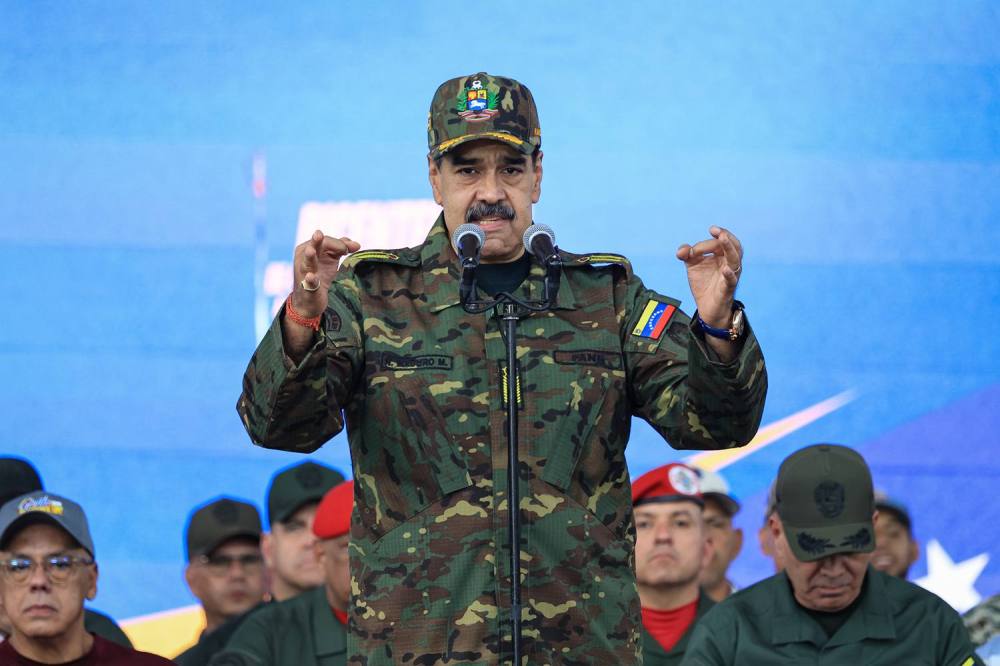
The remarkable criminal case against Venezuelan President Nicolás Maduro, who was captured by U.S. forces in Caracas on Jan. 3, is already underway in New York City. Maduro is not the first foreign leader to stand trial in the United States, but his case is still controversial and unusual.
While much remains up in the air and this legal drama has only just begun, here’s what we know and don’t know about the case against Maduro so far.
The charges. The indictment against Maduro, which also includes his wife, Cilia Flores, and four other individuals, alleges that he and other Venezuelan leaders “abused their positions of public trust and corrupted once-legitimate institutions to import tons of cocaine into the United States” for more than 25 years.
The indictment was filed in the U.S. District Court of the Southern District of New York. Maduro was indicted on four counts: narcoterrorism conspiracy, cocaine importation conspiracy, possession of machine guns and destructive devices, and conspiracy to possess machine guns and destructive devices. The narcoterrorism charges include alleged cooperation with Colombian paramilitary groups such as the FARC and ELN, Mexican drug gangs including the Sinaloa Cartel, and the ubiquitous Venezuelan gang Tren de Aragua. He could face up to life in prison if convicted.
Meanwhile, the indictment accuses Flores of accepting bribes in 2007 to broker a meeting between a “large-scale drug trafficker” and the director of Venezuela’s National Anti-Drug Office. The U.S. complaint also alleges that Maduro and Flores “ordered kidnappings, beatings, and murders against those who owed them drug money or otherwise undermined their drug trafficking operation, including ordering the murder of a local drug boss in Caracas, Venezuela.”
The indictment revises and builds on a 2020 indictment against Maduro that accused him of heading the so-called “Cartel de los Soles,” which experts have emphasized is not an actual organization but a slang term for corrupt Venezuelan officials who accept drug money.
Notably, while the 2020 indictment explicitly accuses Maduro of leading the Cartel de los Soles, the 2026 indictment drops this assertion and no longer refers to it as an organization but a “patronage system.” The 2020 indictment mentioned the Cartel de los Soles a total of 32 times, while the new complaint only mentions it twice.
The Trump administration has repeatedly referenced the Cartel de los Soles in public remarks leading up to and after Maduro’s capture. In remarks to the U.N. Security Council on Jan. 5, for example, U.S. Ambassador to the United Nations Mike Waltz said Maduro is “the head of a vicious foreign terrorist organization Cartel de los Soles.” But the Trump administration is apparently abandoning such assertions in the legal proceedings against Maduro.
The 2026 indictment also differs in that it adds new co-defendants, including Flores. Among the others charged are Maduro’s son, Nicolás Ernesto Maduro Guerra, and Héctor Rusthenford Guerrero Flores, the leader of Tren de Aragua.
The judge. U.S. District Court Judge Alvin Hellerstein, a 92-year-old who has been on the bench for close to three decades, is presiding over the trial. Hellerstein, a Clinton appointee, has a history of ruling against U.S. President Donald Trump. Last spring, for example, Hellerstein barred the Trump administration from deporting migrants under the Alien Enemies Act.
“This is the United States of America,” Hellerstein said at the time. “People are being thrown out of the country because of their tattoos.”
The prosecutors. The U.S. Attorney’s Office for the Southern District of New York, which is led by U.S. Attorney Jay Clayton, is prosecuting the case. Clayton, who chaired the U.S. Securities and Exchange Commission in the first Trump administration, signed the indictment against Maduro and his wife.
Amanda Houle, the chief of the office’s criminal division, is also on the case. Houle was among the lead prosecutors in the 2020 case against Maduro.
Assistant U.S. Attorney Kyle Wirshba spoke on behalf of the government at Maduro’s arraignment on Jan. 5. Wirshba was also involved in the 2020 indictment of Maduro.
The defense. Maduro is being represented by Barry Pollack, an experienced Washington-based attorney with a history of involvement in high-profile cases. Pollack, who early in his career garnered the nickname “Pit Bull” for his tenacity, represented WikiLeaks founder Julian Assange and negotiated the plea deal that saw him released from a British prison. He also previously secured the acquittal of former Enron accountant Michael Krautz.
Mark Donnelly, a Houston-based attorney, is representing Flores. Donnelly, a lawyer with the firm Parker Sanchez & Donnelly, previously worked for the U.S. Justice Department for more than a decade, including as a senior advisor to the U.S. attorney for the Southern District of Texas, according to his online biography.
What’s happened so far. Maduro and Flores were arraigned on Jan. 5 in Manhattan. They pleaded not guilty. “I am innocent. I am not guilty. I am a decent man. I am still president of my country,” Maduro said, speaking through an interpreter. Their next court date is March 17.
Hellerstein vowed to give Maduro a fair trial. “That’s my job, and that’s my intent,” Hellerstein said.
The evidence. Maduro is regarded across much of the world as a corrupt, illegitimate, and undemocratic leader whose policies and actions fomented widespread suffering in Venezuela for years, which the Trump administration has repeatedly noted in justifying its operation to capture him. But Maduro is not on trial in the United States for stealing elections or his treatment of the Venezuelan people.
That said, the Trump administration has yet to provide hard evidence to back up many of its allegations against Maduro, particularly those regarding drug trafficking. Legal experts have expressed doubts that the government has enough direct evidence to back up its charges against Maduro regarding cocaine trafficking and narcoterrorism. Long story short, securing a drug trafficking conviction against Maduro could be extremely difficult.
Along these lines, it’s worth reiterating that the public comments the administration continues to make against Maduro in relation to the “Cartel de los Soles” do not match up with what’s in the indictment itself. The indictment also links Maduro to criminal gangs such as Tren de Aragua, but the U.S. intelligence community last year reportedly assessed that the Venezuelan government was not directing the gang and that the gang wasn’t committing crimes in the United States on the Venezuelan government’s orders.
Whether or not the contradictions between the administration’s public statements and allegations against Maduro will cause issues for the government later on in the proceedings remains to be seen.
If any of the evidence the government has is classified, this could also complicate the case for prosecutors and delay the process. The defense could seek to pressure the government into revealing sensitive information to pressure the prosecution into dropping charges—a tactic known as “graymail.”
The first test: sovereign immunity argument. One of the first questions raised by the abduction and trial of Maduro is the legality of putting a head of state in the dock in another country, and indeed that was the first argument made by defense lawyer Pollack in Maduro’s arraignment hearing. There are actually two questions, both foreshadowed in the 1990 capture of Panamanian strongman Manuel Noriega and his subsequent trial in the United States.
The first is whether it is legal for the United States to forcibly seize a head of state and spirit him away to face justice; almost always bilateral extradition treaties are the preferred way to handle such matters.
But in 1989, the U.S. Justice Department determined that it had the right to seize even a head of state if that person was under indictment in the United States and legal extradition was not an option (as it was not in the cases of Noriega and Maduro). The argument about improper capture did not fly in Noriega’s trial and likely won’t here; at any rate, courts generally defer to a legal doctrine that says the means by which a defendant is apprehended don’t much matter as long as due process is observed in the trial itself.
The second is a little trickier because at the time of his capture Maduro was serving as Venezuela’s president, while Noriega was not legally Panama’s president but merely a dictator. But “President” Maduro carries a caveat: The United States (and about 50 other countries) deemed him illegitimate and not the true president of Venezuela after widespread fraud in the 2024 elections, which he lost in a landslide. The United States argues in its indictment that Maduro was not the head of state.
However, his successor, former Vice President and now acting President Delcy Rodríguez, said in her first public comments that Maduro remained the country’s rightful president. If Venezuela argues before the court that Maduro is the legitimate president and thus enjoys sovereign immunity, that could complicate the early stages of the case. Pollack has promised to pursue that line vigorously.
Other relevant cases. There are a couple of previous cases of Venezuelan officials who faced U.S. federal charges similar to those facing Maduro: Hugo “El Pollo” Carvajal, a former Venezuelan intelligence official, and Clíver Alcalá, a former Venezuelan general. Like Maduro, both were charged with narcoterrorism and trafficking as well as cooperating with the FARC.
Carvajal, who was arrested (more than once) in Spain and eventually extradited to the United States in 2023, pleaded guilty to all charges in June 2025; he faces up to 50 years in prison. Alcalá turned himself in to U.S. officials while in Colombia in 2020, was extradited, and then arranged a plea deal that dropped the narcotics charges for the seemingly lesser charges of cooperating with terrorists; he received a 21-year sentence.
But there are still a couple of puzzling aspects about the U.S. operation and the current case. Diosdado Cabello is the powerful Venezuelan interior minister named in the same indictment as Maduro but who currently serves to maintain the nascent rump regime of Rodríguez. The United States has reportedly warned Cabello that he could share Maduro’s fate unless he steers Caracas in a U.S.-friendly direction.
Vladimir Padrino López, who is still Venezuela’s defense minister in the regime that Washington is currently working with, is also wanted by the United States and is under indictment on cocaine trafficking charges.
And of course, another former Latin American head of state, ex-Honduran President Juan Orlando Hernández, was extradited to the United States, tried, and sentenced to 45 years in prison for trafficking tons of cocaine. But Trump, who made fighting drug trafficking the centerpiece of his campaign against Venezuela, pardoned Hernandez in December, saying last Saturday that he had been treated “unfairly.”

