

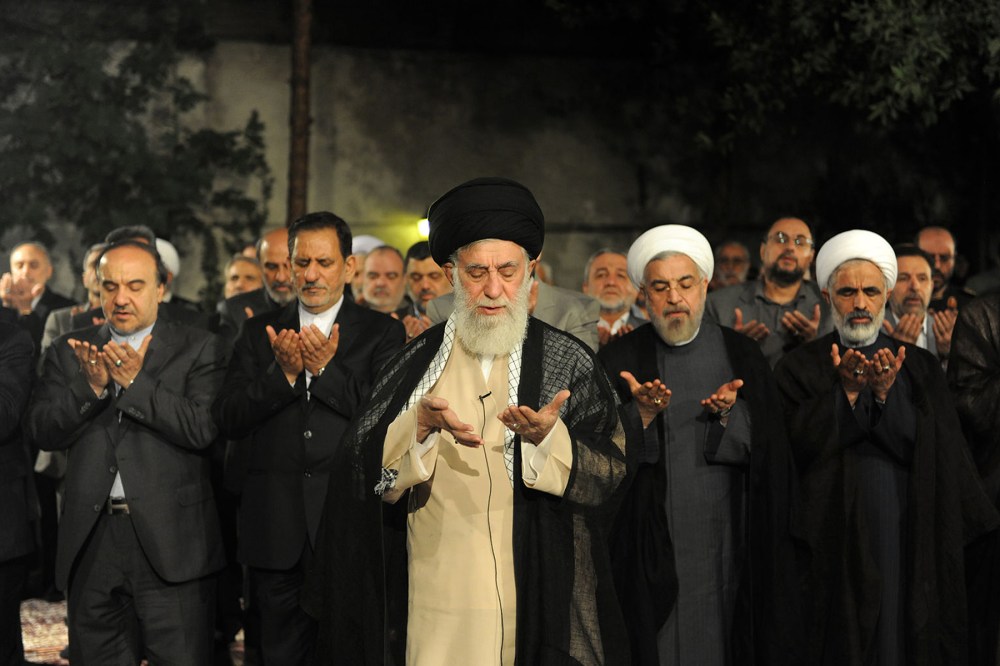
Many if not most successful revolutions boast inspirational leaders followed by less charismatic figures who serve to entrench the new ideology and system of government. Ayatollah Ali Khamenei, the second-ever supreme leader of the Islamic Republic of Iran, exemplified that latter role.
Khamenei never had the fervent following of Ayatollah Ruhollah Khomeini, the founder of the Islamic Republic, and he became increasingly unpopular as his rule dragged on. But after succeeding Khomeini in 1989, Khamenei managed to consolidate the country’s unique cleric-led system and build Iran into a powerful adversary of the United States, Israel, and conservative Arab monarchies.
The longest-serving leader in the Middle East until his death, Khamenei survived numerous personal and political challenges. A 1981 bomb blast, detonated inside a tape recorder placed on a table before him, cost Khamenei the use of his right hand and arm, and mass protests repeatedly rattled his regime. Yet Khamenei outmaneuvered other Iranian leaders who were thought to be more adept.
Initially second in influence to Ali Akbar Hashemi Rafsanjani—who engineered Khamenei’s elevation to supreme leader after Khomeini’s death and served as Iran’s president from 1989 to 1997—Khamenei eclipsed Rafsanjani by building stronger ties to Iran’s military and security establishment.
Khamenei (right) speaks to members of the Iranian armed forces at a battlefront in October 1981, during the Iran-Iraq War. Getty Images Archive
Under Khamenei, the Islamic Revolutionary Guard Corps (IRGC) became a dominant force in the economy as well as in foreign policy. The IRGC spearheaded military operations in Iraq, Afghanistan, and elsewhere; nurtured militias that advanced Iranian interests; and also served as an instrument of domestic repression, suppressing real and potential enemies.
Khamenei used the vast resources of cleric-led foundations to amass property and dispense largesse. He seeded Iranian institutions with representatives of his own office, much in the way the old Soviet Communist Party used local party secretaries and commissars to extend and maintain power. Mindful of how the Soviet Union collapsed, however, Khamenei was ever on the alert for potential “Ayatollah Mikhail Gorbachevs” who might reform the system from within and open it up to Western influence. All were eventually purged or otherwise marginalized.
In the final year of his life, Khamenei faced a series of escalating challenges to his rule, from U.S. and Israeli air campaigns in June 2025 to sustained nationwide protests in January 2026. He responded with unrelenting violence, unleashing hundreds of missiles at Israel in an attempt to restore deterrence and killing tens of thousands of his own citizens. And as the threat of a new war intensified, he refused to meet U.S. demands to abandon the country’s nuclear and ballistic missile programs. Khamenei’s death, from an airstrike at age 86, revealed the limits of his foreign policy and left the future of his regime in grave doubt.
-

Leaders of Iran stand in front of its parliament building. - Then-Iranian President Khamenei (middle with cane), parliament speaker Ali Akbar Hashemi Rafsanjani, and Prime Minister Mir Hossein Mousavi stand outside Iran’s parliament to call for unity in 1986. Kaveh Kazemi/Getty Images
-

Then-Ayatollah Ali Khamenei reviews troops south of Tehran. - Khamenei (left) reviews troops participating in a military maneuver in the desert south of Tehran in 1997. IRNA/AFP via Getty Images
The son of an ethnic Azeri father and a Persian mother, Khamenei was born in the holy city of Mashhad, eastern Iran, in 1939. He was the second of eight children; his family was so poor, by his own account, that sometimes they had only bread and raisins for dinner. As a young child, Khamenei followed his cleric father into the seminary, where he spent his formative years.
Revolution was in his blood. The grandson of clerics who supported a revolt against a previous dynasty in the early 20th century, Khamenei opposed the rule of former Shah Mohammad Reza Pahlavi from an early age. He was outraged by the CIA-assisted coup against then-Prime Minister Mohammad Mosaddegh in 1953 and was inspired as a teen by a militant Islamist, Navab Safavi, who was later executed.
Like his mentors, Khamenei espoused a worldview dominated by intense animosity toward the governments of the United States and Israel—both key supporters of the shah and seen as oppressing the rights of Muslims. He translated into Persian the work of Egyptian Islamic revolutionary Sayyid Qutb and demonstrated his fervent anti-Zionism by wearing a checkered Palestinian scarf around his neck. (Khamenei was also a huge fan of author Victor Hugo’s Les Misérables, which he described as “miraculous.”)
Khamenei studied in the Iranian Shiite center of Qom, where he encountered Ayatollah Khomeini at a time when Qom was becoming a center for opposition to the monarchy. Jailed repeatedly for anti-government activities—including participating in demonstrations and acting as a courier for Khomeini tracts—he was tortured by the shah’s Mossad- and CIA-trained secret police as well as SAVAK, Iran’s former secret police. He was also sent into internal exile in the eastern province of Sistan and Baluchistan. He reemerged after the 1979 revolution to assume a series of important posts, including two terms as president after the death of Mohammad Ali Rajai in a terrorist bombing in 1981.
Khamenei was able to rise to the position of supreme leader only after the rejection of a more senior cleric, Ayatollah Hossein Ali Montazeri, who had been Khomeini’s first choice. Khomeini revoked that decision after Montazeri criticized him for authorizing the summary execution of 5,000 political prisoners in 1988 at the end of the Iran-Iraq War.
Khamenei, who lacked Khomeini’s religious credentials, was “promoted” to ayatollah (“sign of God”) only after his selection as supreme leader. As Iran’s directly elected presidents took more active and overt roles in domestic governance and foreign affairs, Khamenei solidified control quietly, building up his internal pillars of power.
Khamenei was stunned, however, when reformist cleric Mohammad Khatami beat an establishment candidate in the 1997 elections and sought to remake the Islamic Republic into a kinder, gentler Islamic state. Khatami—who, like many Iranian reformists, had lived in the West before the revolution—advocated a “dialogue among civilizations,” including with the United States, and more personal, political, and intellectual freedom at home.
Khamenei, fearful that these reforms would erode clerical rule and strict Islamic social controls, responded by undercutting Khatami’s administration, authorizing the closing of newspapers and the prosecution of key Khatami officials. He also used agents from the deep security state to mount physical attacks on top reformers.

Khamenei (left) attends the inaugural ceremony of new Iranian President Mahmoud Ahmadinejad (right) in Tehran on Aug. 3, 2005.ATTA KENARE/AFP via Getty Images
Khamenei openly supported a conservative, Mahmoud Ahmadinejad, in the 2005 presidential elections and again in 2009, when Ahmadinejad allies in the security services and interior ministry rigged the vote count to give Ahmadinejad a second term.
The police, IRGC, paramilitary Basij, and judiciary all worked together to crush post-election protests, known as the Green Movement—the largest since the Iranian Revolution—jailing numerous reformists and putting opposition candidates under house arrest. These events damaged Khamenei’s legitimacy. Chants of “death to the dictator” became a regular feature of anti-government demonstrations going forward.
While constantly inveighing against the United States, Khamenei benefited from U.S. strategic blunders, especially the 2003 invasion of Iraq. He exploited U.S. overreach to increase Iran’s own regional influence.
After the overthrow of Iraqi leader Saddam Hussein, a member of Iraq’s Sunni minority, Iran became the most powerful external actor in Iraq by organizing and bolstering Shiite political factions and militias. The Iranians also expanded their influence elsewhere in the region: They (along with Russia) propped up the brutal regime of Syrian President Bashar al-Assad, helped Hezbollah become the most powerful political and military force in Lebanon, and cemented a stronger bond with Houthi rebels in Yemen after a bungled Saudi-led intervention there in 2015.
Khamenei could be pragmatic, however. Occasionally, he even supported tacit cooperation with the United States—for instance, against the Taliban in Afghanistan after the Sept. 11, 2001, attacks and in the battle against the Islamic State in 2014.
The Iranian leader invoked what he called “heroic flexibility” to approve direct negotiations with the United States that led to a landmark nuclear agreement in 2015: the Joint Comprehensive Plan of Action (JCPOA). Khamenei had authorized the advancement of Iran’s nuclear program in the 1990s and early 2000s, insisting that Iran was not after bombs but alternative sources of energy as well as technological prowess—a claim greeted with some skepticism, particularly by Israel.
However, the decision by then-U.S. President Donald Trump’s administration to quit the JCPOA in 2018—at a time when Iran was in full compliance—vindicated Khamenei’s long distrust of the United States and his view that Washington was only seeking regime change in Iran.
Khamenei tilted toward hard-line candidates in the 2020 parliamentary elections and supported the disqualification of any plausible opponent to judiciary chief Ebrahim Raisi in the 2021 presidential vote. As a result, the already flimsy democratic and republican aspects of the Islamic Republic shriveled up on Khamenei’s watch.

Khamenei arrives to cast his ballot for the Islamic Republic’s presidential election on June 18, 2021. ATTA KENARE/AFP via Getty Images
As occurred in the Soviet Union after the death of former Soviet leader Vladimir Lenin, important supporters of the revolution were sidelined in Khamenei’s Iran. These included some of Khomeini’s relatives, including two grandsons, Hassan and Hossein, and a great grandson, Ahmad.
The most dramatic downfall was that of Rafsanjani, who sided with the Green Movement in 2009 and was prevented from running for president again in 2013 by a Khamenei-controlled vetting body. Two of Rafsanjani’s children have served prison terms. Rafsanjani himself died in 2017, officially from a heart attack. The family questioned the cause of death, and a government investigation was launched in 2018, without producing results.
The regime also for a time marginalized another once-prominent family: the Larijanis. Ali Larijani, a former speaker of parliament and nuclear negotiator, was barred from running for president against conservative hard-liner Raisi in 2021. To replace these stalwarts, Khamenei promoted his own relatives, especially his second son, Mojtaba, as well as assorted in-laws, conservative clerics, and veterans of the Iran-Iraq War. However, Larijani was politically resurrected in the run-up to the latest U.S. and Israeli attacks on Iran and made head of Iran’s Supreme National Security Council, sidelining the current president, Masoud Pezeshkian.
“I’m reluctant to say how strong the system is and how strong it is not,” John Limbert, a former U.S. diplomat held hostage in Iran from 1979 to 1981, told Foreign Policy in early 2022. Limbert, one of the very few Americans to meet Khamenei—he was a hostage when the then-deputy defense minister visited Limbert and his captive colleagues in 1980—said Iranian leaders had benefited from “the incompetence of their opponents, their willingness to be brutal, and to compromise when necessary.”
That was certainly the formula Khamenei used to cling to power for so long—and the formula that proved unable to forestall his violent end.

