
In the aftermath of the ouster of Venezuelan President Nicolás Maduro by the American military, U.S. President Donald Trump said 30 million to 50 million barrels of oil would be turned over to the United States by the new Venezuelan government. It was Trump’s first explicit embrace of what he calls the “Donroe Doctrine,” an expanded version of the Monroe Doctrine under which the United States claims the right to control economic decisions made across the entire Western Hemisphere. But what exactly motivates that policy—whether capitalist profit or geoeconomic strategy or even cultural considerations—remains unclear.
Will U.S. oil companies benefit from the intervention in Venezuela? What sort of economics might inform the sphere-of-influence policy? Or is the Donroe Doctrine more about a show of force in the region?
Those are just a few of the questions that came up in my recent conversation with FP economics columnist Adam Tooze on the podcast we co-host, Ones and Tooze. What follows is an excerpt, edited for length and clarity. For the full conversation, look for Ones and Tooze wherever you get your podcasts. And check out Adam’s Substack newsletter.
Cameron Abadi: One theory of imperialism is that it’s motivated by the interests of major capitalists—Lenin’s theory of imperialism as capital accumulation, for example. In what ways does that framework apply to Trump’s Venezuela policy?
Adam Tooze: The fact that we are asking this question is itself astonishing, that theories of imperialism from 120 years ago, from the age of Teddy Roosevelt and the Rough Riders, might be relevant. And I think they undeniably are. There is at least a basic plausibility to the Leninist resource-imperialist kind of theory. I mean, is the United States interested in oil? Well, of course it is, like everyone else.
But there’s also a basic implausibility, which is that the business case just isn’t there. And it’s very difficult to point to specific business interests lobbying hard for this to happen. There’ve been moments in American history where you could say, American business interests lobbied hard for American interventions on the part of the U.S. state. And it’s true that Exxon, for instance, and ConocoPhillips have rulings outstanding against Venezuela. But there just doesn’t seem to be any smoking gun. There just doesn’t seem to be any clear evidence that their interests were powerfully involved in shaping this policy. In fact, they seem to be scrambling in a rather embarrassed and shame-faced way to find ways of concerting their strategy with the administration.
And those who track the Trump administration very carefully suggest that there really was a kind of ex-post rationalization and that the early case was really driven by the whole narcoterrorism-type allegations, much of which have just sort of evaporated in thin air. And they thought maybe they could get some media traction on that side, apart from the spectacular hit. And then when that failed, well then, the last resort is always some sort of resource imperialist claim.
But it’s not the same as actual resource imperialists banging on the doors of the State Department and the Pentagon and saying, “Hey, can we take over Venezuela? We really need to, this is why.” That’s obviously not our situation. It seems almost as though they do the action and then figure out why it might have made sense to. And they’re not very imaginative, so they come up with these bad answers.
CA: Even if Venezuela’s oil resources are made available to the United States, how would that play out for the U.S. economy?
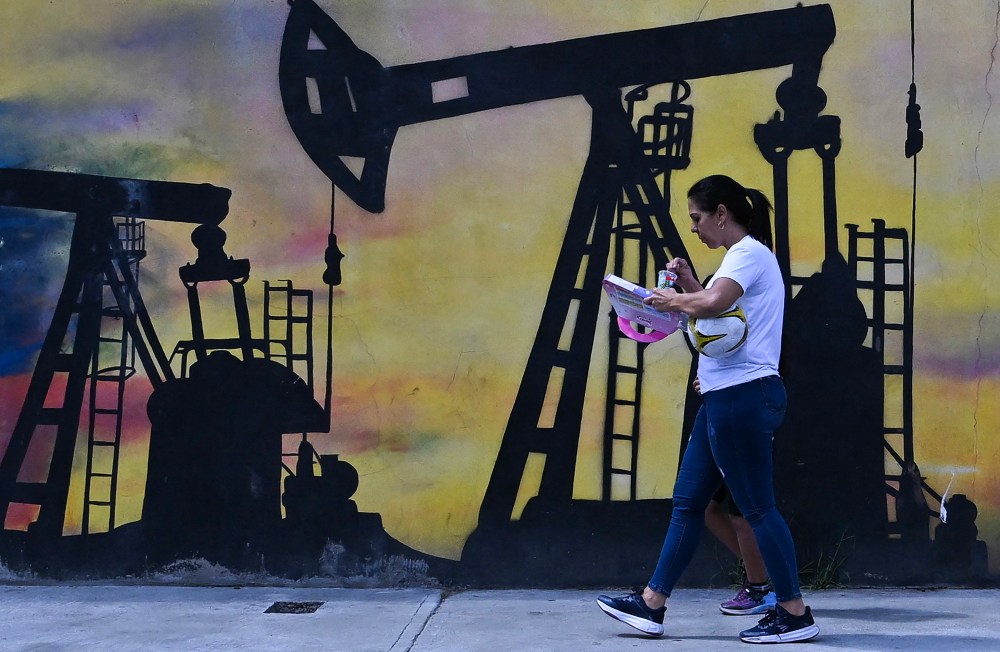
AT: We have to start with this thing called the Orinoco formation [in Venezuela], which clearly is an absolutely remarkable geological feature of the planet. It appears to be the largest reservoir of oily stuff that there is anywhere in the world. But as everyone’s now seen on TV or video, presumably, the oil there is viscous. It’s tar, right? It’s like somewhere between chewing gum and oil. It’s not as you imagine oil, sweet and free-flowing.
And so why would an American oil major like Exxon, which is an intensely bottom-line, highly efficient corporation, even consider—setting aside the politics and the engineering difficulties of doing this, and the fact that they would need to reboot a derelict, broken-down oil infrastructure that has been ruined by mismanagement and politics and sanctions. Why would they spend money there? Life is short, resources are scarce. Why would you pump them into rehabilitating Venezuela when right next door you have one of the most promising oil finds in recent memory in Guyana, which you’re deeply involved in? And there isn’t any evidence that somehow in the back room they’ve been cooking up this plan, and it’s not even clear what the plan is, if there is one.
CA: It does seem like Trump is interested in lowering oil prices for the sake of consumers.
AT: This is the dilemma, right? America has this incredible boon of really sweet, light oil from fracking. But America is not your average oil power, because it has the world’s largest oil industry, but it also has one of the largest markets. And so it’s structurally betwixt and between, because an oil producer basically wants the highest prices that don’t kill demand. And an American politician wants the lowest prices that don’t kill production. And that doesn’t work with a high-cost marginal supplier like Venezuela, which isn’t even in the game at prices which are attractive for American consumers.
The question is, would anyone in their right mind sink $100 billion into expanding this production, which is always going to be high-cost? And then struggling to somehow make a profit out of that, why would anyone do that when you could put $100 billion into Guyana?
CA: Some have suggested the Venezuelan intervention is more simply a product of sphere-of-influence grand strategizing. Is that a more useful way to understand what’s going on here?
AT: Maybe. I mean, if you’re looking for rationalizations. Javier Blas from Bloomberg, their commodities guy, who’s often really great, did this piece I’ve been thinking about a lot in the past couple of days where he’s pointed out that if you credit the United States with a degree of political sway over the Western Hemisphere, which the United States would clearly like to claim—but the Brazilians would, of course, hotly contest; the Mexicans, too—but if you did, then you would say that the United States has political sway over about 40 percent of global oil production. And at the very least, what they can then do is harden themselves against other big blocs’ efforts to, in some ways, strangle the United States. So there will be a kind of basic defensive logic. And Blas goes on to say that what we’ve seen with Trump in Venezuela, in Iran, these sort of light-handed strikes are the geopolitics of an unconstrained United States. So it gives sovereignty, it gives you the power to act, because you aren’t worried about pressure from the outside.
It’s an interesting argument. The number is striking—40 percent of the world’s oil production. Much of that is coming from Canada, Mexico, and Brazil, but you are crediting America with some degree of influence. So it’s a stretch, but still, let’s go there.
So then I think another question would be: The Biden administration implored the U.S. oil industry in 2022 to expand the output, and they just didn’t, and they just let prices go up. So I don’t know the extent to which this actually translates. The sphere of influence may be a space you can mark on a map, but do you actually have any degree of control or integration over it? If you look at trade patterns, the United States is by a long stretch no longer the major trading partner of many countries in Latin America, because China is. And taking out the head of government in Venezuela isn’t going to change that.
There are different factions in the Trump administration. And if you could usefully distinguish between them, you might say that there’s [White House deputy chief of staff] Stephen Miller—with an utterly Darwinian kind of vision of the world, which also just happens to serve his boss. And then you’d have to choose between what people are calling the [Vice President] J.D. Vance and the [Secretary of State] Marco Rubio kind of factions within the administration. And they’re different because Rubio is a more kind of conventional neocon. And Vance is really an American-first isolationist. The kind of sphere-of-influence vision, a souped-up 21st-century Monroe Doctrine, feels more like a Rubio kind of vision, where a lot of us were speculating about whether Cuba is the next domino to fall, or is it Colombia that really is being put under pressure here? And I think we don’t know, and we don’t understand, and I don’t think even the people in Washington understand. And one way of modeling this is, this is a kind of power play between these different groups.
CA: Does that leave a more postmodern logic of empire—imperial violence, of the sort at work in Venezuela, as a spectacle for shaping domestic narratives and international perceptions? Is that a coherent way to think about empire in the age of Trump as well?
AT: I mean, it’s the one that’s staring us in the face. The efforts to find some sort of logic in the oil industry, the efforts to superimpose some philosophy of history and politics are all ways of avoiding the far more obvious fact that this is almost entirely driven by that logic of spectacle, of drama. And what’s really astonishing are these opinion polls, because my initial response is like, no one in America is calling for this. Like, there isn’t some big jingoistic mob calling for an invasion of Venezuela.
And I have to say that at some level, I find that more compelling than asking myself, how does this fit in the balance sheet of Exxon? Because I’m pretty certain it doesn’t fit in the balance sheet of Exxon. And then there’s a spectacular element of the violence, but then there is also something absolutely real about it. Real people are actually being killed. Real force is being asserted, real dominance. It’s genuinely American ships off the Venezuelan coastline. Real crews in real boats, running drugs or not, who knows, people are literally just being struck from the air and annihilated. They went in, they grabbed Maduro and his wife, and they killed 80 people on the way in and the way out. Sure, it’s a spectacle. But unlike wrestling, people are actually dying.

