

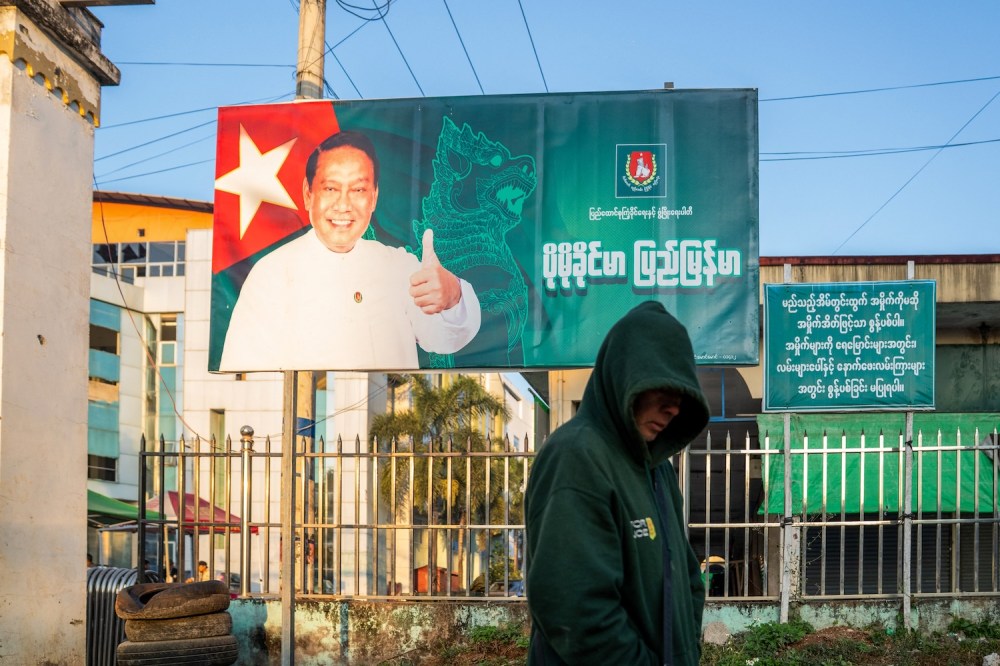
When a limited number of Myanmar’s citizens go to the polls beginning on Dec. 28, the outcome of the election—the first since the military seized power in a 2021 coup—won’t be in question. The ruling junta is expected to carefully choreograph the proceedings to continue its rule under a civilian guise.
The Union Solidarity and Development Party (USDP), a proxy for the military, is running effectively unopposed. Former democratic leader Aung San Suu Kyi has been jailed since the coup; her twice-elected National League for Democracy party was officially dissolved in 2023 after the military said it refused to comply with a strict new registration law.
Though the election result is predetermined, many questions remain. Will the polls be marred by violence? Will the military be able to hold elections in all the areas that it plans to, given the massive civil war that the coup sparked? How will the election be received by the international community, especially regional neighbors? Who will ascend to the presidency?
It has been widely reported that China is pushing for the election to take place, as it is frustrated with junta leader and commander in chief Min Aung Hlaing but sees the pro-democracy movement as too influenced by the West. Beijing hopes that the election could serve as a reset, diffusing power among more stakeholders. This could also open the door for peace talks, which could stabilize fighting on the China-Myanmar border and near key infrastructure projects.
Other observers warn that this is unlikely. Richard Horsey, the senior Myanmar advisor for the International Crisis Group, wrote this month that the election may be followed by some strategic cease-fires between the government and specific powerful armed groups, but it “will do little to address the deeper causes of the conflict.”
Due to the ongoing turmoil, voting on Dec. 28 will be limited to 102 of Myanmar’s 330 townships, with another 100 townships slated to vote on Jan. 11, 2026. The remaining townships—making up nearly 40 percent of the country’s total—might get their turn later in January, but also may not participate at all. (Townships are the basic administrative unit of Myanmar and are subdivisions of districts, which are subdivisions of the country’s states or regions.)
This week’s first phase of voting is mostly concentrated in regime-held territory but also includes some areas of mixed control, such as Myawaddy township, where the military only holds the two main towns and the highway connecting them. The other rounds would include more conflict-riven areas.
The election could be a flash point for violence, but so far, there have only been a handful of attacks on pro-military party officials—as documented by the International Crisis Group—which have been routine since the coup. A member of the New Mon State Party told Foreign Policy last month that the group will not allow voting in its territory, and that it heard that people in rural areas will be brought into towns to vote.
The Association of Southeast Asian Nations (ASEAN) has grown increasingly weary of Myanmar’s conflict. The organization—which nominally includes Myanmar—operates on a consensus basis, leaving it gridlocked on the issue. Countries such as Indonesia, Malaysia, the Philippines, and Singapore have taken a hard line against the military regime, while Cambodia, Laos, Thailand, and Vietnam have advocated for engagement.
The bloc reportedly discussed whether to send election observers to Myanmar during a regional summit in October, ultimately leaving the decision up to individual member states rather than sending an ASEAN delegation. Thailand plans to send observers, with its foreign minister saying that the polls could be “the starting point of some positive developments.”
“I agree that many ASEAN nations would like to put the crisis behind them,” said Scot Marciel, a former U.S. ambassador to Myanmar. “Some probably are willing to accept the elections, but others are hesitant, which explains why the recent ASEAN meetings did not result in an agreement to send election observers.”
ASEAN took the lead in responding to the crisis in Myanmar in the immediate wake of the coup, holding an emergency summit and appointing rotating special envoys. But the country’s most powerful neighbors—namely, China, Thailand, and India—have increasingly bypassed the organization.
In 2023, Thailand initiated dialogues among the Myanmar junta, neighboring countries, and the ASEAN members open to engagement. China has mediated cease-fires between the regime and rebel groups that operate on their shared border while pressuring the groups to cut ties with the pro-democracy movement. In an effort to counter Chinese influence, India broke with precedent and engaged with nonstate armed groups—including reportedly cooperating with the Arakan Army on an infrastructure project—while also cozying up to the regime.
These three countries seem to see the 2021 coup as a fait accompli and the regime’s survival as inevitable, and so they aim to stabilize the chaos even if that means further propping up the regime. Meanwhile, the junta’s critics within ASEAN appear to be increasingly hopeless about a democratic transition. Though they may symbolically snub a post-election government for a few more years, genuine isolation might begin to thaw.
Saifuddin Abdullah, Malaysia’s foreign minister from 2021 to 2022, advocated for isolating the regime during his tenure. He said that he tried to convince his counterparts in Thailand to do the same, but ultimately, they “were not on the same page.” Abdullah added, “Because Thailand is bordering Myanmar, it’s not that they should have a bigger say, but you have to acknowledge that they are on the front line when it comes to the problem.”
What’s more, key U.S. allies such as the Philippines and Singapore may now be less incentivized to prioritize Myanmar. The Philippines is the incoming ASEAN chair, and it will have its hands full with Chinese aggression in the South China Sea. The Biden administration pushed for ASEAN to isolate Myanmar, but in November, the Trump administration announced an end to temporary protected status for citizens of Myanmar in the United States, including democracy activists, citing the “improved” situation and “plans for free and fair elections.”
Tom Andrews, the United Nations special rapporteur on the human rights situation in Myanmar, said last month that the U.S. assessment of the election was “inconceivable,” warning that activists who are forced to return to Myanmar could face “detention, torture, forced conscription, and execution.”
With the United States seemingly disinterested and ASEAN’s unity fractured, even countries that are sympathetic to Myanmar’s pro-democracy movement may want to put this chapter of the conflict in the rearview mirror.
“Many regional governments will use the election and the emergence of a nominally civilian administration as political cover for reengaging” with the regime, Horsey told Foreign Policy. “China certainly will, and others will follow its lead—not because they believe the polls are credible, but because they assume the military will endure.”
A lingering barrier to normalization is Min Aung Hlaing, who is rumored to covet the presidency, which is currently unoccupied. Allowing him to represent Myanmar at ASEAN summits might be a bridge too far for countries such as Indonesia and Malaysia. The U.N. has found evidence of crimes against humanity in Myanmar since the coup, and troops under Min Aung Hlaing’s command killed thousands of Rohingya Muslims during a 2017 military campaign that has been condemned by international observers as genocide.
In Myanmar’s highly militarized climate, the commander in chief position is probably more powerful than the presidency, though, and in recent months, Min Aung Hlaing appears to have been exploring a Plan B. In July, his key ally Nyo Saw was appointed prime minister during a preelection cabinet reshuffle. Nyo Saw retired from the military in 2020—before the coup, crucially—and serves as the chairman of a military-aligned business conglomerate.
Were a nominal civilian like Nyo Saw or even the head of the USDP to serve as president of Myanmar, it might be easier for other countries in the region to claim that the upcoming election represents a modest step in the right direction. However, during five years of crisis, Min Aung Hlaing has shown little inclination to compromise on his objectives for the sake of international legitimacy.
It’s not clear what position Min Aung Hlaing will take, possibly because the decision hasn’t even been made yet. “At this point, no one knows who would be the president or the shape of the government and the parliament. That is the sentiment among major actors in Naypyitaw,” political analyst Min Zaw Oo said, referring to Myanmar’s military-dominated capital.
ASEAN will likely remain divided after Myanmar’s election, with some members recognizing the new government while others hold the line. But what the bloc thinks may no longer be important as China, Thailand, and India increasingly take matters into their own hands.
“That’s a worry we’ve had for many years,” Abdullah said. “We may lose the opportunity to play a substantial role.”

