

Not long ago, Western policymakers were writing the obituary of China’s Belt and Road Initiative (BRI). That verdict is now dangerously obsolete. The stark reality of 2025 has shattered the narrative of a Chinese retreat. Far from a quiet dissolution, BRI project values have now rebounded and eclipsed their 2016 peak. New data shows that in a staggering show of fiscal and geopolitical resilience, BRI projects reached $213.5 billion across regions and a wide array of sectors last year. This resurgence occurred alongside a tectonic shift in China’s commercial standing; in 2025, total foreign trade surpassed $6.3 trillion, yielding a record-breaking trade surplus of near $1.2 trillion.
The BRI hasn’t just returned; it has also been fundamentally repurposed. Once a vehicle for massive infrastructure projects, it has evolved into a sophisticated extension of China’s industrial policy. Driven by both domestic and external pressures, the modern BRI now operates in lockstep with Beijing’s broader economic statecraft to achieve three core aims: dominating frontier sectors such as clean technology, securitizing critical mineral supply chains, and relieving domestic overcapacity through aggressive export expansion.
Ironically, the escalation of U.S.-China trade tensions since April 2025 and growing Western protectionism have only accelerated this transformation of Beijing’s expansive export campaign. Squeezed by mounting trade walls, Chinese firms are leveraging targeted BRI investments to systematically reroute their supply chains through lower-tariff jurisdictions, preserving indirect access to Western markets.
Simultaneously, Beijing is deploying this capital surge to capture emerging, non-U.S. markets to absorb its massive production. The BRI is back, it is bigger, and it is being built on the very walls that Washington intended to keep it out.
The BRI’s transformation from an infrastructure drive into a nimble instrument for techno-industrial consolidation is no accident. It is a strategic imperative engineered to alleviate compounding pressures squeezing the Chinese economy from opposite directions. At home, China is grappling with a severe overcapacity crisis, forged by decade-long industrial policies and exacerbated by stubbornly weak post-pandemic consumer demand.
Sustained by immense government subsidies—estimated by the International Monetary Fund to be at roughly 4.5 percent of GDP—manufacturing capacity has relentlessly expanded, regardless of limits in domestic absorption. In 2025, approximately 24 percent of Chinese industrial firms operated at a loss, kept afloat largely by state-directed credit from local governments desperate to meet growth targets and maintain social stability. Unable to offload the output at home, export expansion became a matter of sheer corporate survival.
This domestic glut birthed China’s record-high 2025 trade surplus, an export boom driven overwhelmingly by green and high-tech industries. According to China’s State Council, high-tech exports jumped 13.2 percent last year. The surge in clean energy products was even more staggering: Exports of electric vehicles (EVs), lithium batteries, and solar panels rose by 27.1 percent, while wind turbines skyrocketed by 48.7 percent.
Externally, however, China’s economy faces a parallel challenge. Just as Chinese firms pivot toward aggressive global expansion, Western doors are slamming shut. Through its trade policies, Washington has built high barriers, pushing average effective import tariffs to near 16 percent—the highest level since 1936. Direct Chinese exports to the United States thus plunged by 20 percent in 2025. Similarly, the European Union slapped punitive countervailing duties of up to 45.3 percent on Chinese EVs in 2024, deploying a far more decisive response than its halting reaction to Chinese solar products a decade ago.
Caught in the vice of domestic overcapacity and market access restrictions, Beijing has reinvented the BRI, reflecting China’s broader economic statecraft anchored by China’s “new development” paradigm and “dual circulation” strategy—both promulgated by the country’s 14th Five-Year Plan. The former focuses on the transition from low-end to high-end production; the latter seeks to foster domestic innovation (“internal”) while strategically leveraging global trade (“external”) to bolster supply chain security.
Both initiatives have continued to be driven by China’s internal economic headwinds, as well as intensifying competition with the United States. At the Central Economic Work Conferences in both 2023 and 2024, President Xi Jinping called for the mobilization of “new quality productive forces” to bolster the security and resilience of industrial supply chains, directing massive state support for industrial upgrading in sectors including clean energy, high-tech industries, and advanced manufacturing.
In practice, however, chronic domestic underconsumption has forced the “external” pillar into overdrive. Consequently, the retooled BRI serves as the vital physical infrastructure for this external circulation. By integrating partner nations into China’s industrial ecosystem, Beijing aims to secure access to upstream critical minerals, create alternative downstream markets, and engineer new channels to Western consumers.
Beijing’s policy mandate has triggered a striking sectoral shift on the ground. In 2025, BRI construction projects in technology and manufacturing hit a record $28.7 billion. These projects—mostly loan-financed—targeted EV battery factories, semiconductor facilities, and data centers. Concurrently, outbound foreign direct investment (FDI) in green energy manufacturing—spanning solar, wind, hydropower, and hydrogen—reached an all-time high of $18.3 billion.
To bypass Western barricades, Beijing’s BRI strategy operates along two primary axes. The first is “tariff-jumping” via supply chain relocation. By aggressively seeding manufacturing capacity in intermediary, lower-tariff jurisdictions, Chinese firms preserve indirect access to Western consumers. In Southeast Asia, Chinese FDI into Indonesia, Malaysia, Thailand, and Vietnam has quadrupled in the past decade, concentrated in electronics and EV assembly.
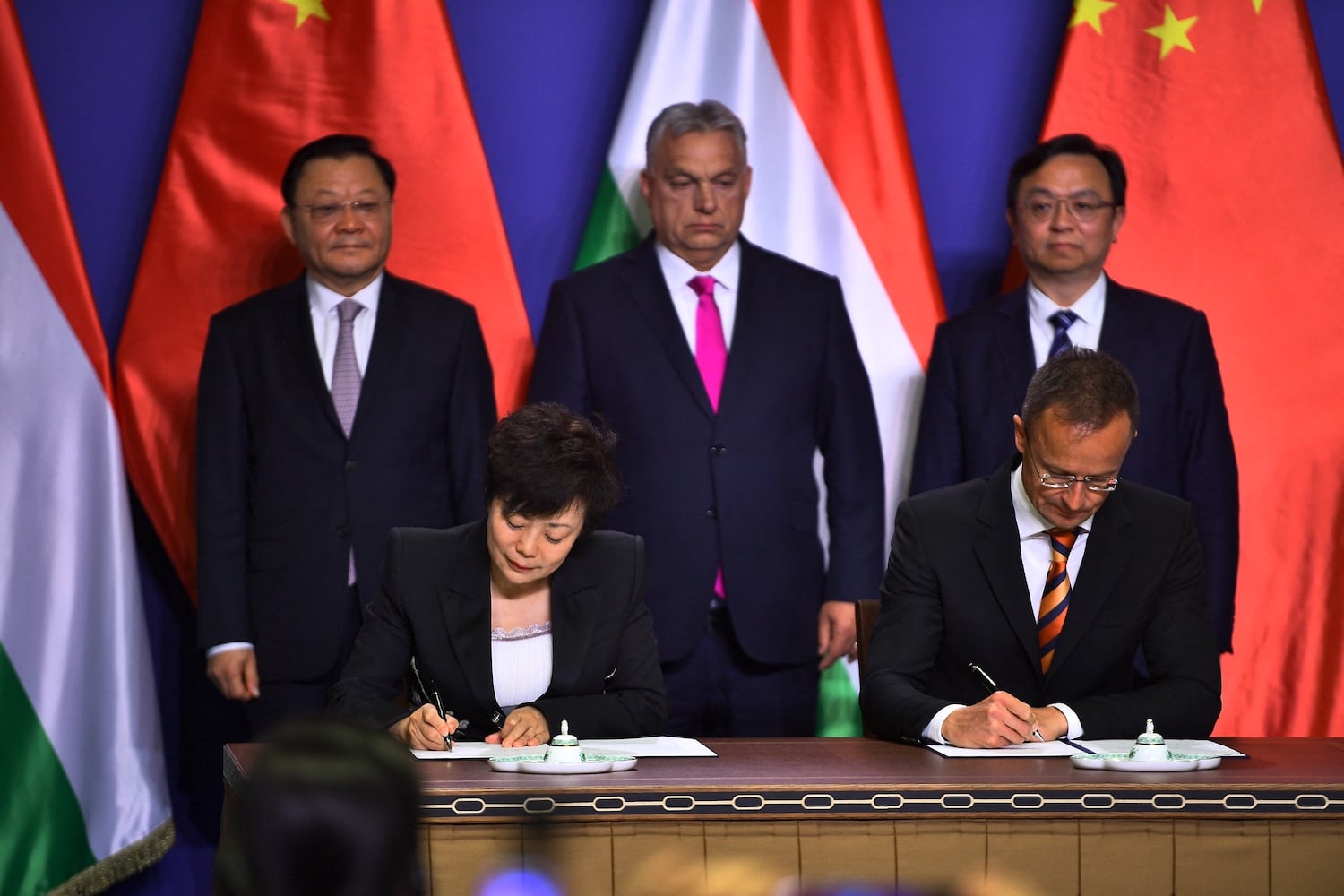
Moreover, firms are geographically leapfrogging across the globe to minimize tariff exposure. Boway Alloys, for instance, canceled a planned Vietnam plant in favor of moving production to Morocco, capitalizing on a much friendlier 10 percent U.S. tariff rate. Longi Energy is investing in Nigerian green hydrogen initiatives to relocate cleantech production away from punitive U.S. levies. Similarly, BYD’s new factory in Hungary allows the automaker to bypass the EU’s countervailing duties—which include a 17 percent levy specifically targeting vehicles assembled in China—by securing European “country-of-origin” status for its finished cars.
The second axis turns the BRI into a global market-maker, leveraging partnerships and infrastructure to cultivate the global south as a consumer base for Chinese manufactured goods. While direct exports to the U.S. plummeted last year, China’s 2025 bilateral trade with BRI countries reached 23.6 trillion yuan (about $3.4 trillion), increasing 6.3 percent year on year and accounting for 51.9 percent of the country’s total foreign trade value.
Africa stands out as the focal point of this realignment. Offering a new market and low U.S. tariff exposure, Africa’s overall BRI projects surged by an astonishing 283 percent in 2025 to reach $61.2 billion. Correspondingly, Chinese exports to the continent jumped by roughly 18 percent, making it the top destination for Chinese export growth.
Crucially, this downstream market expansion requires securing the upstream: the global vertical integration of critical raw materials. In 2025, BRI mining investments climbed to $32.6 billion, heavily concentrated in copper, aluminum, and lithium extraction across resource-rich nodes such as Kazakhstan, the Republic of Congo, and Indonesia.
Yet, this cleantech dominance is driven by ruthless commercial pragmatism. To power its sprawling global industrial engine, China requires immense traditional energy inputs, meaning that the new BRI is far from unequivocal “greening.” The total value of BRI construction contracts in oil and gas sectors, primarily in the Middle East, was $71.5 billion in 2025, dwarfing clean-energy investments. Put simply, market-making logic, not environmentalism, reigns supreme in the BRI resurgence. Similarly, despite Beijing’s 2021 pledge to stop building overseas coal-fired plants, pragmatic loopholes remain wide open. Billions of dollars continue to flow into “off-grid” captive coal plant construction, powering China’s expanding overseas mining operations and industrial parks, serving to deepen trade ties with non-Western markets.
In essence, the BRI is no longer just a connectivity project; it is central to Beijing’s economic defense. By optimizing its position in global supply chains and deepening integration with the global south, China is utilizing the BRI to ensure that no matter how high Western tariff walls grow, it cannot be marginalized.
If the BRI’s pivot toward overseas manufacturing and cleantech represents the “hardware” of China’s economic statecraft, then its proliferating network of free trade agreements (FTAs) and related pacts provides the essential “software.”
Beijing has paired its physical investments with a quieter campaign to foster “soft infrastructure.” Moving beyond simple tariff reductions, this parallel effort targets regulatory frameworks of the global trade regime. The objective is to engineer a favorable rule-based ecosystem that protects, amplifies, and integrates Beijing’s hard assets. The goal is no longer just to build the roads and ports; it is to write the rules and manage the ledgers for every transaction passing through them.
Trade pacts and physical megaprojects now work in tandem to resolve China’s domestic oversupply and outflank Western barriers. To this end, FTAs serve two interlocking functions. First, they establish the legal certainty and institutional facilitation required to anchor complex transnational operations.
Singapore illustrates this dynamic. Backed by the upgraded China-Singapore FTA, which took effect in December 2024 to significantly expand access to services and investment, Chinese capital flow into the city-state skyrocketed in 2025. For the first time, China became Singapore’s top source of foreign fixed-asset investment, capturing a total commitment of $2.26 billion. The agreement also secured a staging ground necessary for Chinese firms to deploy investments across Southeast Asia.
Second, trade agreements are the legal linchpins for regional supply chain integration—the very mechanism making China’s “tariff-jumping” viable. By harmonizing customs rules and lowering cross-border friction, megapacts such as the Regional Comprehensive Economic Partnership allow Chinese companies to source domestic components, assemble them in third-party nations, and export the finished products to the West or back to China under preferential terms; a process reinforced by economic zones that cluster logistics, manufacturing, and trade hubs to link China’s interior more closely with Southeast Asian markets. Through this architecture, Beijing is institutionalizing a formidable Sinocentric trade bloc that, as of 2025, accounted for about 30 percent of both global GDP and world trade.
To secure the resources needed for its techno-industrial buildup and the markets required for its massive production, Beijing’s soft infrastructure offensive extends well beyond Asia. In a bold display of zero-tariff diplomacy, Beijing announced in February that it will completely eliminate import duties for 53 African nations.
This sweeping market access complements the physical BRI build-out. By opening its own doors to African goods, Beijing helps Chinese firms win on both sides—securing vital natural resources while ensuring reciprocal access for manufacturing exports. This strategy is being mirrored across the global south, as Beijing is courting Latin America to forge trade pacts and accelerating FTA negotiations with Gulf states to cement deeper integration.
Beijing’s BRI pivot and free trade offensive underscore the mounting limitations of Washington’s trade strategy. Rather than halting China’s global integration, unilateral tariffs have merely redirected its industrial overcapacity. By anchoring manufacturing in BRI hubs across the global south, Chinese firms are restructuring global trade, emerging more agile, resilient, and increasingly insulated from U.S. economic leverage.
Developing nations must navigate the hidden costs of a resurgent BRI. While affordable Chinese imports offer immediate benefits, they often exert a competitive squeeze that can stifle nascent local industries. Evidence from Southeast Asia—where trade deficits and job loss have widened in sectors from steel to textiles—indicates that China’s regional influence extends well beyond physical infrastructure.
This intensified competition risks anchoring the global south in a prolonged middle-income trap. Compounded by shifts toward Western protectionism, many of these countries lack the alternative strategic partnerships required to effectively rebalance their economic dependencies and protect domestic manufacturing.
The path forward requires Washington to recognize that an inward-looking, tariff-on posture is a recipe for strategic irrelevance. To counter China’s strategy, the United States must return to positive economic statecraft. Moving beyond defensive de-risking, Washington must lead a multilateral coalition with like-minded partners in the global south to offer rules-based alternatives with tangible incentives. The BRI has returned, but its permanence is not yet guaranteed.
Disclaimer: The authors’ views expressed here are personal and do not reflect the official policy or position of the Department of the Army or any U.S. government entity.

