Seeking additional barrels of oil in Venezuela or digging for rare earths in ice-covered Greenland makes no sense from an economic or security point of view. And yet U.S. President Donald Trump persists, even though the costs massively outweigh the benefits.
In reality, naked resource grabs explain a lot about Trump’s dizzying foreign policy, perhaps even more so than other explanations that have been proposed. It seems Trump may have reached back even further in time for his guiding light than tariff-happy William McKinley and big-stick imperialist Theodore Roosevelt to the British and Dutch quasi-state mercantilist corporations that introduced much of the world to rapacious capitalism starting in the 17th century. The British and Dutch East India Companies did grab much of the world, usually at gunpoint. At least they got pepper, spices, and tea. All we have here is sulfurous oil and neodymium.
Gunboat diplomacy is back, only this time without the diplomacy.
Trump’s obsession with natural resources that the companies paid to extract them refuse to touch does raise several questions. Are these even the right resources to be grabbing? Is any of this legal? And most importantly, is any of this a remotely good way to promote the security of the United States?
When it comes to oil, which has been a Trump obsession for decades, the answer is clearly no.
Oil demand is a tricky thing to project into the future. Some forecasters expect global demand for oil to peak within five years, while others reckon fast-growing developing economies will still be thirsty into the next decade, requiring more wells and more production. Either way, oil from Venezuela and Greenland is not the answer.
Venezuela’s oil woes have been amply demonstrated. It’s an expensive thing to produce in a place with little security and less rule of law, especially with oil languishing in the mid-$50s a barrel. The chairman and chief executive of ExxonMobil, Darren Woods, told Trump at a White House meeting last week that Venezuela was “uninvestible.” Trump then said he would ensure that Exxon was kept out of any U.S.-led Venezuela ventures—and Exxon’s stock rose on the news.
Greenland, too, is rumored to have oil: billions of barrels of it. It’s not clear if that is actually the case, because decades of exploration have hit only dry wells, but on paper, Greenland could have 8 billion barrels of oil hidden under the tundra and the whitecaps, or nearly 3 percent of Venezuela’s unattractive reserves.
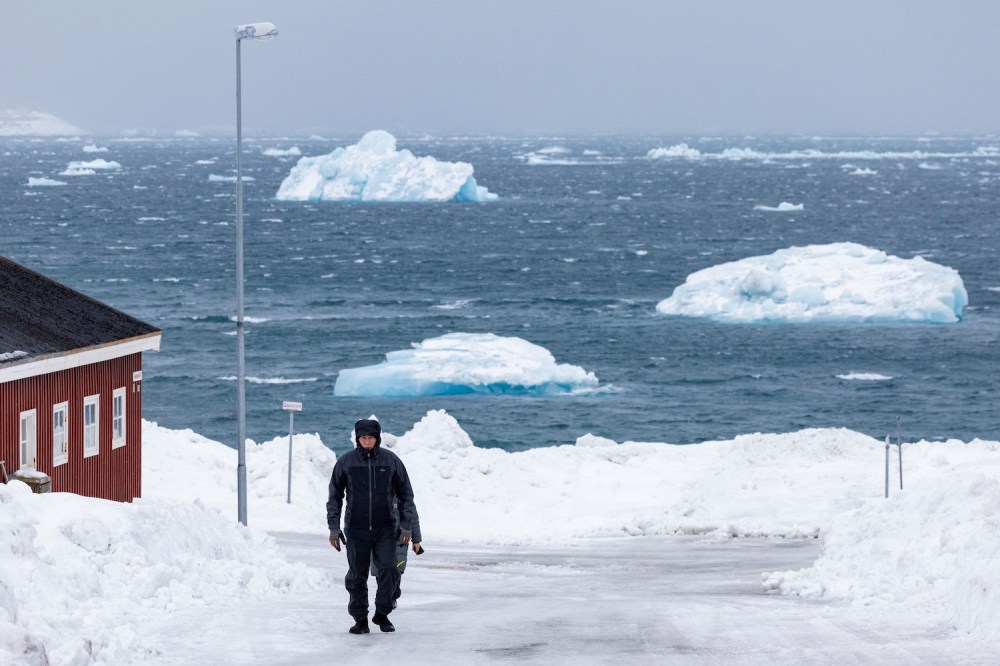
But there are some daunting challenges. Most of those estimated oil resources are north of the Arctic Circle, and mostly offshore. That is not easy to access, even with climate change stretching summer on both ends. Even the oil on land is not easy to tap. There are fewer than 100 miles of paved road on an island the size of Mexico. Deep water ports, airports, pipelines, oil-export terminals, housing, clinics—all are on somebody’s to-do list to build, but not that of oil majors.
Also relevant: Since 2021, Greenland has banned further oil exploration due to environmental concerns. The only current play, a land-based oil-exploration operation on the island’s east coast with U.S. backing, relies on a grandfathered lease from years ago. That legal stricture, in the absence of a complete annexation, could complicate further U.S. efforts to tap Greenland’s possible oil.
But what about Greenland’s rare earths, which Trump officials have suggested are one of the primary reasons the U.S. president is so interested in the island?
While those who focus on rare earths mining simply say the plan is “bonkers,” the real issue is that rare earths are not rare—processing facilities and magnet factories are. Which makes a race for ice-bound dodgy mining prospects in somebody else’s territory all the harder to understand.
“It certainly doesn’t make any sense as a rare-earth story,” Ian Lange, a professor in the mineral economics program at the Colorado School of Mines, recently told Foreign Policy.
Rare earths, or a set of 17 metallic elements with obscure names like neodymium and samarium, have catapulted in geopolitical importance because they power everything from F-35 fighter jets to Arleigh Burke-class destroyers. China overwhelmingly commands their global supply chains, giving it powerful leverage in its ongoing trade spat with the United States.
Sure, Greenland may have some sizable rare earth reserves, according to the U.S. Geological Survey—but so do many other countries. And a big economic question hangs over potential operations in Greenland, where no rare earth mining has ever taken place and mining itself remains a fraught and divisive issue.
Also, the bulk of Greenland’s land—a whopping 80 percent—is estimated to be covered in ice. All of those factors are certain to make establishing crucial mining and processing infrastructure, already a difficult and hefty financial endeavor, even more costly and challenging.
In his pursuit of rare earths, industry experts say, Trump will likely have an easier time looking elsewhere.
And then there’s the question of the legality of how Trump is going about his resource grabs. Abducting heads of government to seize resources is not anywhere sanctioned in the U.N. Charter, nor is threatening to invade a NATO alliance partner to forcibly annex their territory. But rogue states are hard to red team.
Trump has waved aside centuries of international law, telling the New York Times “I don’t need international law,” because his own “morality” was the only check or balance required.
It’s not an abstruse debate. For centuries, the West has sought to paint a patina of law over the anarchy of the international system, and even today, tomes are written about revisionist powers seeking to pervert international law for their own ends. Until very recently, the United States was not among the revisionist powers.
But there’s little to be done on that front. Trump’s installed successor in Venezuela, Nicolas Maduro’s former vice president and now also acting president Delcy Rodriguez, who has been under U.S. sanctions since 2017 for human rights abuses, is according to Trump “a terrific person.” Also not entirely legal is storing the proceeds of Venezuelan oil sales the United States has carried out in an offshore account in Qatar.
Maria Corina Machado, the Nobel Prize-winning opposition leader of Venezuela who Trump met at the White House on Jan, 15, doesn’t command respect or support in her native country, Trump said previously, a position he seemed to maintain even after she gifted him her prize medal.
And when told that the premier of Greenland, a semi-autonomous territory of Denmark, was opposed to his takeover, Trump responded: “I don’t know who he is….but that is going to be a big problem for him.”
The biggest problem with Trump’s resource grabs is not their lack of economic foundation, which is nil, or their legality, which is none, but with what they do for U.S. security, which is little or worse.
Just take Venezuela and Latin America for a start. In 1914, the United States blundered into the Mexican revolution, launched a naval and amphibious assault, occupied Veracruz, and took over its customs revenues for months. “Diplomatically, its seizure was a disaster that soured Mexican-American relations for decades. Operationally, the concentration of nearly half the Marine Corps and practically the entire Atlantic Fleet at Veracruz and Tampico was a masterpiece of rapid deployment,” the U.S. Naval Institute notes. (As an aside, 24 years later, Mexico would nationalize all the U.S. oil holdings in Mexico.)
The United States did nearly the same thing, only longer and harder, in the Dominican Republic, with the last invasion coming in 1965. There were a few coups otherwise, most notably in Guatemala and Chile, but the rancor was and is widespread. In the interim, President Franklin D. Roosevelt sought a “good neighbor” policy, and he nearly got it right, but then Washington reverted to form. It’s reverting again.
But it is the NATO front that is more concerning. Denmark, Germany, France, Sweden, and a bunch of other NATO nations have sent troops to Greenland in recent days to forestall the threat of an invasion, not from an outside power, but from a NATO alliance member. Danish Prime Minister Mette Frederiksen said that the defense of Greenland is a “common concern” for NATO members, who until recently were wargaming invasions of the Baltics by Russia.
It is hard to overestimate the magnitude of this shift. For 76 years, NATO has manned, albeit poorly at times, the ramparts looking outwards. Never did it occur to the alliance that the attack would come from the other direction. The latest survey by the European Council on Foreign Relations is eloquent. Other than India, nearly every country surveyed has lost faith in the United States, and less than one-fifth of Europeans view the United States as an ally.
Trump doubled down on the trans-Atlantic impasse over the weekend, threatening tariffs of 10 percent and later 25 percent on the European countries that sent troops to bolster Greenland’s security, the very thing Trump said he was worried about. British Prime Minister Keir Starmer, who has sought to maintain the special relationship with Washington, was blunt in a Monday speech, decrying a new trade war.
The European Union, meanwhile, is dusting off plans for more than 90 billion euros in retaliatory tariffs that had been parked earlier and is again talking of the financial “bazooka,” a never-before-used economic authority that could put the pain on a state that economically coerces the 27-nation bloc.
At the same time, Trump complained to Norway that much of the reason for his pique over Greenland was because he did not win the Nobel Peace Prize. The Norwegian government (which does not administer Greenland) keeps explaining that it does not award the prize but to no avail.
The great advantage the United States had, until recently, was its network of alliances: NATO, Japan, South Korea, and a multitude of others. That’s all gone now, or nearly. It is surely a sign of bungled foreign policy when Sweden dispatches troops against you.