
On Feb. 15, 1991, as coalition bombs fell on Iraq during Operation Desert Storm, President George H.W. Bush addressed the Iraqi people. “There is another way for the bloodshed to stop,” he declared, “and that is for the Iraqi military and the Iraqi people to take matters into their own hands and force Saddam Hussein, the dictator, to step aside.” Coalition aircraft dropped leaflets calling on Iraqis to “fill the streets and alleys and bring down Saddam Hussein and his aides.”
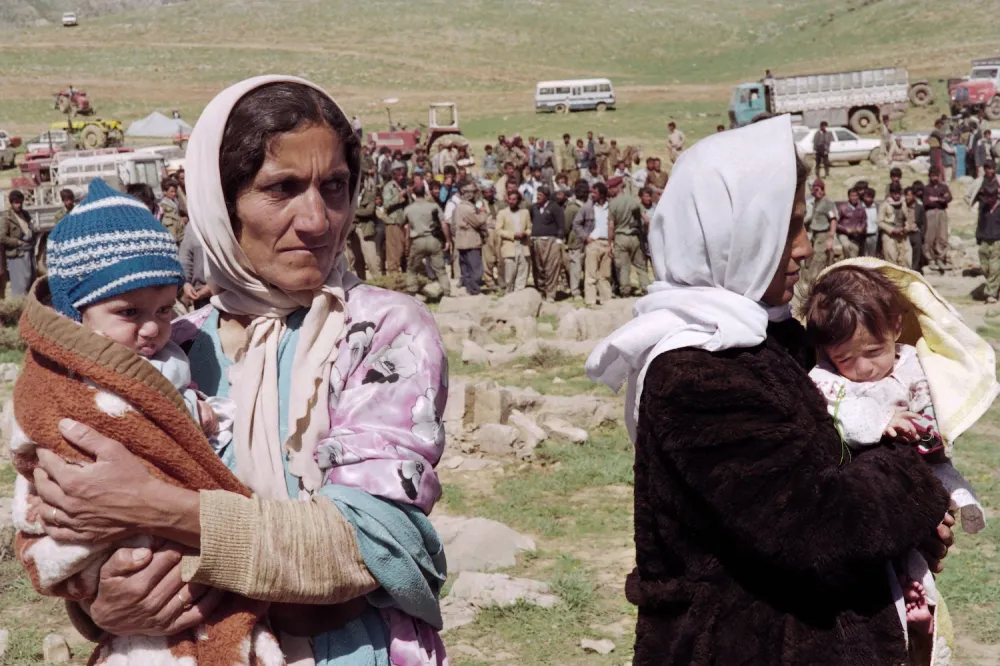
A few weeks later, Shiite rebels in southern Iraq and Kurdish fighters in the north rose up. At the peak of the uprising, 14 of Iraq’s 18 provinces had slipped from government control. And then—nothing. The Bush administration provided no support, actively blocked the transfer of captured Iraqi weapons to rebels, and allowed Saddam to use helicopter gunships to crush the uprising. While Iraq was prohibited from flying fixed-wing aircraft, Gen. Norman Schwarzkopf permitted the use of helicopters. Between 30,000 and 60,000 Shiites and some 20,000 Kurds were killed. Over 1.5 million Kurds were displaced, and thousands died from exposure, disease, and land mines.
On Feb. 15, 1991, as coalition bombs fell on Iraq during Operation Desert Storm, President George H.W. Bush addressed the Iraqi people. “There is another way for the bloodshed to stop,” he declared, “and that is for the Iraqi military and the Iraqi people to take matters into their own hands and force Saddam Hussein, the dictator, to step aside.” Coalition aircraft dropped leaflets calling on Iraqis to “fill the streets and alleys and bring down Saddam Hussein and his aides.”
A few weeks later, Shiite rebels in southern Iraq and Kurdish fighters in the north rose up. At the peak of the uprising, 14 of Iraq’s 18 provinces had slipped from government control. And then—nothing. The Bush administration provided no support, actively blocked the transfer of captured Iraqi weapons to rebels, and allowed Saddam to use helicopter gunships to crush the uprising. While Iraq was prohibited from flying fixed-wing aircraft, Gen. Norman Schwarzkopf permitted the use of helicopters. Between 30,000 and 60,000 Shiites and some 20,000 Kurds were killed. Over 1.5 million Kurds were displaced, and thousands died from exposure, disease, and land mines.
Bush’s defense was remarkable in its brazenness. “Do I think that the United States should bear guilt because of suggesting that the Iraqi people take matters into their own hands, with the implication being given by some that the United States would be there to support them militarily?” he asked a few weeks later. “That was not true. We never implied that.”
This was a lie by any reasonable reading. But as U.S. President Donald Trump’s behavior so far seems to suggest, it was also part of a long pattern.
Washington’s template for betrayal was established decades earlier. In October 1956, Hungarians took to the streets of Budapest to demand an end to Soviet domination. What followed was an inspiring several weeks of resistance, but also a catastrophic miscalculation about American intentions.
Radio Free Europe (RFE) had been broadcasting into Hungary for years. While scholars still debate whether RFE explicitly promised Western military support, the emotional tone of its broadcasts during the uprising left little ambiguity. A survey of Hungarian refugees afterward found that nearly 40 percent believed Western broadcasts had given the impression that the United States would fight to save Hungary. RFE even broadcast instructions for making Molotov cocktails. As a Wilson Center study concluded, “Western broadcasts evidently encouraged Hungarians to think that the United States would not let the Revolution be crushed.”
The Soviet Union let the rebels believe they had won, then sent in the tanks. When the dust settled, 2,500 Hungarians were dead, 700 Soviet soldiers had been killed, and 200,000 Hungarians had fled the country. U.S. President Dwight D. Eisenhower, preoccupied with the Suez crisis and unwilling to risk a nuclear confrontation, did nothing. As he later put it, “The United States doesn’t now and never has advocated open rebellion by an undefended populace against force over which they could not possibly prevail.”
Less than two decades later, Henry Kissinger was the architect of another betrayal. In 1972, at the Shah of Iran’s request, Kissinger and President Richard Nixon organized a covert operation to arm and encourage Iraq’s Kurdish population in their rebellion against the Baathist regime. Over the next three years, the United States channeled $16 million in military aid. This was enough to sustain the insurgency but, crucially, not enough to win. As the Pike Committee later discovered, “The president, Dr. Kissinger, and the foreign head of state hoped that our clients would not prevail. They preferred instead that the insurgents simply continue a level of hostilities sufficient to sap the resources of our ally’s neighboring country.”
The Kurds did not know about Kissinger’s cynical calculation. Kurdish leader Mustafa Barzani trusted the Americans implicitly; he sent Kissinger three rugs and then a gold necklace as a wedding gift. When the Shah abruptly cut off support in 1975 after reaching his own deal with Baghdad, the Kurds were blindsided. Barzani wrote to Kissinger: “We feel, Your Excellency, that the United States has a moral and political responsibility towards our people.” There was no reply. Thousands of Kurds died, and 200,000 became refugees.
When pressed by the House Intelligence Committee about the betrayal, Kissinger offered what has become the definitive statement of American realpolitik toward those it encourages to fight: “Covert action should not be confused with missionary work.” The congressional investigators were appalled. “Even in the context of covert action,” the Pike Committee concluded, “ours was a cynical enterprise.”
The pattern has continued with numbing regularity. In Syria, President Barack Obama provided just enough support to the opposition to keep the civil war grinding on without resolution, before famously backing down from his chemical weapons red line when it was crossed in 2013. In October 2019, Trump abruptly withdrew American forces from northeastern Syria after a phone call with Turkish President Recep Tayyip Erdogan, effectively green lighting a Turkish assault on the very Kurdish forces that had served as America’s main ground ally against the Islamic State. The Kurds, who had lost over 11,000 fighters in the campaign against the Islamic State, were left to face Turkish bombs and artillery. As American convoys drove away, Kurdish civilians pelted them with rotten vegetables. “Trump betrayed us,” read one sign held along the road.
What explains this recurring pattern? The charitable interpretation is that these are a series of individual miscalculations: tactical errors by different presidents, compounded by the fog of crisis. But the consistency of the pattern across decades and administrations suggests something structural.
American foreign policy operates on two tracks that rarely connect. The rhetorical track, which focuses on freedom, self-determination, and solidarity with those who resist tyranny, serves domestic political purposes and reflects genuine ideological commitments embedded in American national identity. The strategic track, however, operates on political interests, risk calculations, and the hard limits of power. Presidents speak on the first track and act on the second. The people who take American rhetoric seriously—sometimes more seriously than Americans themselves—end up falling into the gap.
Encouraging dissent in adversarial states is cheap: It costs little money and no American blood and creates problems for rivals while allowing U.S. politicians to feel morally righteous. But the cost of actually supporting those movements is high. The result is a perverse set of incentives where leaders talk big and act small. When the moment comes, they suddenly discover pressing reasons why this particular uprising cannot be supported after all.
There is also a more cynical possibility contained in Kissinger’s remarks, one that doesn’t even require hypocrisy. Uprisings that get crushed still serve American interests by bleeding adversaries, delegitimizing rival regimes, and creating martyrs. By this logic, the failure of American promises is not an unfortunate downside but part of the strategy itself.
Which brings us to Iran. As protests spread across the country in recent weeks, Trump adopted characteristically aggressive rhetoric. “If Iran shots [sic] and violently kills peaceful protesters, which is their custom, the United States of America will come to their rescue,” he posted on Truth Social. “We are locked and loaded and ready to go.” Days later, as the death toll climbed into the thousands, he urged Iranians to “KEEP PROTESTING – TAKE OVER YOUR INSTITUTIONS!!!” and declared that “HELP IS ON ITS WAY.”
Obama famously held back during Iran’s 2009 Green Movement, reasoning that American support would only give the regime a pretext for crackdown. He later called this decision “a mistake.” Trump has no such hesitations, but his approach raises its own questions.
In one sense, Trump represents a collapse of the two-track system described above: His rhetoric bleeds into strategy, or at least, there’s no clear gap between them. He says what he thinks, consequences or national interests be damned. But this doesn’t necessarily make him more reliable. It may simply mean that the old pattern of encouragement followed by abandonment will play out faster and more chaotically. Already, analysts note that any U.S. military action is more likely to target Iran’s nuclear facilities or military infrastructure than to actually aid protesters on the ground. As one Iran expert put it, striking nuclear sites would be “helping the United States, maybe in terms of its strategic aims or friends like Israel. It’s not helping the protest movements.”
There is something else here that sets Trump apart. The calculated betrayals of Eisenhower, Kissinger, and Bush were born from a surplus of caution. They knew exactly where the line was and refused to cross it for fear of nuclear war or regional instability. The danger with Trump’s current treatment of Iran is not just that the rhetorical and strategic tracks are merging, but that the strategic track might not exist at all. Trump’s betrayal, if it comes, won’t happen because of a cold, Kissingerian calculation but because of a whim, a distraction, or a transactional shift. To the victims, the result is the same. But for observers of American policy, the mechanism of failure is different. One is ruthless competence; the other is chaotic incompetence.
This does not mean the United States should abstain from encouraging those fighting authoritarian regimes. But it does suggest that American policymakers should be honest about the gap between rhetoric and action. And those who hear American promises should be deeply skeptical about what exactly is being offered. The Kurds have learned this lesson too many times over the past century.
As for the victims of 1991, they eventually got their answer. When Colin Powell, who served as chairman of the Joint Chiefs of Staff during the Gulf War, published his memoirs in 1996, he admitted that Bush’s rhetoric “may have given encouragement to the rebels.” But he also revealed what American strategic thinkers actually believed at the time: The real purpose, he said, was “to leave Baghdad enough power to survive as a threat to an Iran that remained bitterly hostile toward the United States.”
As Powell’s stark admission shows, the freedoms of those who took Bush at his word were never the point. The American encouragement of those freedoms was part of a cynical strategy. And the lesson is not just for the Kurds or Iranians to be skeptical, but for the American public to stop being duped by their own presidential moralizing.
The Iranian people listening to Trump today have heard American promises before. Whether Trump represents a genuine break from this pattern or simply its latest and most volatile iteration remains to be seen.

