
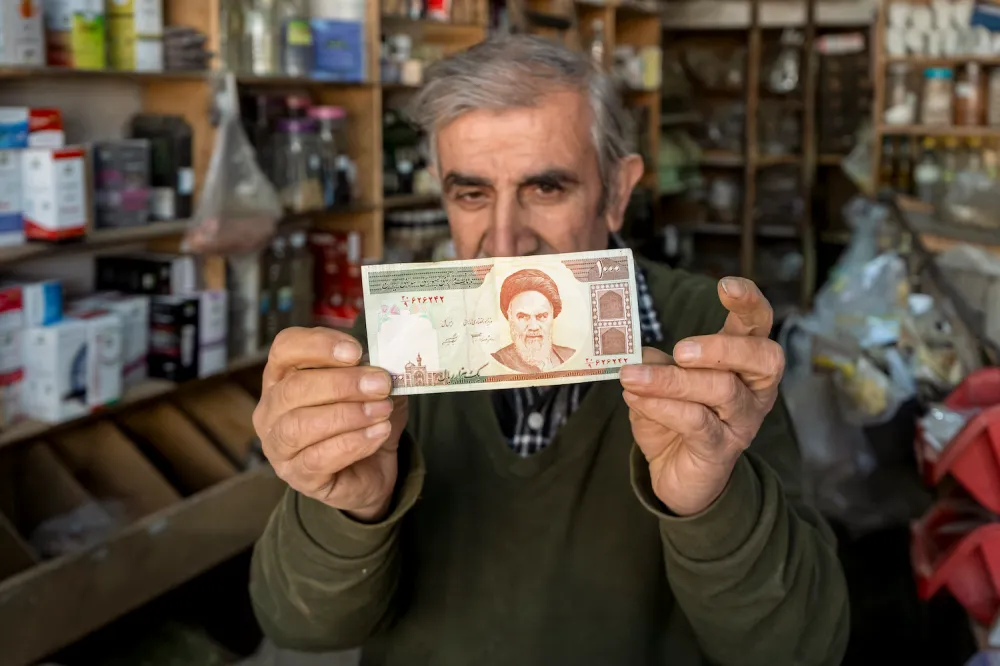
The uprising in Iran that resulted in a deadly crackdown last week was fueled at its root by economic grievances. Iran’s currency has fallen precipitously in value after years of sanctions and economic mismanagement, with one U.S. dollar now worth some 1.4 million Iranian rials. The protest movement seems quelled for now. But the public’s economic demands have not been addressed.
How financially unstable has Iran become? What circumstances led to the emergence of the Pahlavi crown prince as a leading opposition figure? What’s at stake in a potential Iranian regime change?
Those are just a few of the questions that came up in my recent conversation with FP economics columnist Adam Tooze on the podcast we co-host, Ones and Tooze. What follows is an excerpt, edited for length and clarity. For the full conversation, look for Ones and Tooze wherever you get your podcasts. And check out Adam’s Substack newsletter.
Cameron Abadi: How weak exactly has the Iranian currency become? And more generally, how economically unstable had the country become on the precipice of these demonstrations?
Adam Tooze: What a lot of people are saying is very significant about these protests, which began in Tehran’s Grand Bazaar on Dec. 28, is that they are not about specific issues or politics but a general sense of economic malfunction. And the fact that they started in the bazaar is itself significant, because the bazaar is not just a bazaar in the sense you might understand it as a tourist but it is actually a major hub of Tehran’s economy. And politically and historically, it’s played a key role, going back over 100 years—all the way back to the constitutional revolution in Persia, what became modern Iran, in the beginning of the 20th century. So it’s that kind of an upheaval, the sense that the ground is shifting.
The trigger here is the exchange rate, which has fallen. Basically, it seems to halve against the U.S. dollar every year, which creates an exponential acceleration, a brutal devaluation of the currency. They’ve had to actually change the currency unit to allow people to cope. It’s really a delegitimizing process. Anyway, everyone agrees that this undermines political legitimacy, and we’re seeing it. The actual inflation rate is less extreme, but it’s bad. It’s running at more than 40 percent, which is very painful. And for food items, we’re talking about 70 percent.
If you look at the GDP numbers, and even if you look at the currency, it looks more like a progressive, horrendous squeeze that is reaching a critical point rather than a banking crisis like the one in 2008. People do worry about the stability of the Iranian banking system. And the key issue may be around inequality. A lot of people are saying what we’re really missing is the fact that ordinary Iranians—say, the bottom half of the income distribution—are barely able to cope. It’s a kind of Venezuelan situation, of just people really struggling to put food on the table. And that is, in a sense, the fundamental driver here of illegitimacy. Things are not helped by a massive and pervasive network of corruption.
Because if you are having a purely market-operated system and the currency devalued, that’s one thing. But Iran doesn’t. To cope with the stresses of sanctions, it has a tiered exchange rate system. And that gives you some managerial control, but it also just opens the door to massive corruption, with insiders being able to get access to hard currency and protect their wealth. Other people aren’t able to. And that then produces a sort of spiraling delegitimization. So if you ask me whether this looked like it had the makings of a macroeconomically driven destabilization, I think you’d absolutely have to say, yeah, that’s precisely what it looks like. And the current government is one that was actually put in, in a sense, to take responsibility. The central bank governor resigned.
But in a situation like this, just looking historically at the record of countries under this kind of pressure, it gets worse politically before it gets better.
CA: Reza Pahlavi, the crown prince of the Pahlavi dynasty, has now emerged as a kind of symbol of this uprising, with some in Iran calling for his return and Pahlavi himself suggesting he would be ready to do so if circumstances allowed for that. What are the economic circumstances under which Pahlavi is assuming this leadership role? What sort of wealth did the Pahlavi family have after leaving Iran? And how, exactly, has Reza Pahlavi built an opposition from abroad?
AT: There was quite a lot of forensic accountancy done in 1979, when the Pahlavi family went into exile, that looked into how much wealth they took with them. Because they were fabled for their wealth and spending. You know, they bought slices of German companies, they had these huge foundations, they had a huge slice of the Iranian economy, which was booming at the time with the oil revenue. I mean, the Germans really couldn’t get enough of Iran in the 1970s, right? Because Iran’s a huge country and, a bit like China, it actually needed German engineering kit to modernize. So it’s not like the United Arab Emirates, which can’t even absorb, really, the wealth it has. Iran could easily absorb its wealth and turn it into imports.
And so, when the Iranian monarchy went into exile, they took a lot of wealth with them. We think it’s billions. It’s not very well accounted for, but it’s certainly billions. There were some shenanigans around property that was owned by the Pahlavi Foundation in New York. I think a lot of that actually ended up being suborned by the Iranian regime. That, at least, was the case for American prosecutors. But we think that the dowager empress, Farah Pahlavi, who was once a Jacqueline Kennedy kind of figure, has been sitting on hundreds of millions of dollars. She’s very active in philanthropy. And the crown prince—apparently, people think his budget is in the tens of millions of dollars. And that kind of wealth, if you start from where they did in ’79, you’re still wealthy now 40 years later, even if you’ve been spending like a king.
A lot of the Pahlavi movement’s funding also apparently comes from the hugely successful Iranian diaspora, which is unsurprising—you know, if you can mobilize Cuban resistance abroad, you can certainly mobilize Iranian resistance. It has, after all, been one of the most consequential diasporas in the world, in the United States, in Europe. And so, that is there, and it’s potent. But it is, I have to say, shocking to really be even having to have this conversation. And I mean, if you look online, associations closely linked to Pahlavi are actually producing transition documents. I mean, they’ve got, like, 170 pages of economic policy. I looked at it a little bit this morning. It’s not great. There’s not actually a lot there, but are they setting themselves up to look like a credible alternative? They clearly are attempting to do that. It would really be one of the more amazing reversals of the 21st century if that’s the direction we end up heading in.
CA: What geopolitics are at stake in how Iran develops from here? China is notably reliant on Iranian oil. If there’s a change in regime in Iran that would seek closer ties to the United States, is that something that China should be concerned about?
AT: On paper, Iran and China are close allies. In 2021, they signed a big 25-year agreement. After the confrontation with Israel and the war with Israel in last June, there were rumors of Chinese military flights. After the performance of Chinese aircraft in the Pakistan-Indian clashes last year, people were speculating about the Iranians wanting some of the new Chinese hardware. If you dig into this, my sense is that it’s misleading. So it is true that Iran is incredibly dependent on China as an oil market, as was true for Venezuela, as well, but the reverse isn’t the case. So the vast majority of Iran’s still continuing exports of oil, especially the ones we can trace, to China. And quite a lot of Iranian oil is exported through dark channels and ends up in China, because China’s a huge economy, and they have these teapot refineries—tiny little outfits on the coast of China, and they buy oil from tankers that spend a lot of time parked off Malaysia and Singapore, waiting to go somewhere and hoping that people lose track of them, right? That’s one side of this. As a share of China’s imports, it’s about 13 percent. And if you add Venezuela, it’s another 3 percent. So that’s 16 percent of Chinese imports of oil that come from these two hotspots of geopolitics right now. And to be honest, China’s doing them a favor by buying their oil, right? And China gets a discount for buying Iranian oil to the tune of $8 to $10 roughly.
But if you just tweak middle-sized suppliers like Iran or Venezuela, all you do is affect choices by China to do bilateral deals. Because if China wants oil, it can just go to the general market and buy oil. It doesn’t need to do these particular deals with these countries. And if you have regime change in either Venezuela or Iran, or both, they’d still want to be selling to China. China’s a prime customer. They’ve got amazing credit. They’re the whale in the oil market. Of course, you’re going to want to sell to them. And the only reason right now that you’re in this kind of world, in which we track individual tankers from these second-tier oil suppliers to particular destinations, is because of the sanctions regime.
If we lift the sanctions regime on Iran, it’s the same as with Venezuela. You don’t need to occupy Venezuela to get Venezuelan oil for the United States. You just need to stop boycotting Venezuela, and Venezuela will try its damndest to sell you the oil, right? This isn’t real estate. We’re not haggling. Oil is one gigantic pool of oil, and you put your stuff out there. And then, in the end, of course, contracts emerge and then statisticians can measure how much goes from one country to the other. So, unless this spirals toward World War III, other scenarios of dramatic change would, generally speaking, open the market even more.

