

For several months in 1976, John Gach had a unique job.
“I’m the only person I know that has ever been a lighthouse keeper,” says Gach, who is now 70 and lives in Woodstock, Illinois.
Park Ridge resident Wayne Barton, 88, was also a part of the exclusive club more than a decade earlier in the late 1950s. He says people called them “wickies,” because in the early days, lighthouse keepers relied on oil lamps to produce a sustainable glow, requiring them to routinely trim the lamps’ wicks.
But Barton and Gach aren’t that old. By the time the Coast Guard posted them at the Chicago Harbor Lighthouse, it was more a flick of the switch. The structure was electrified in the 1920s.
Still, Barton says between duties like light maintenance, weather monitoring and night shifts, the role was serious and deliberate.
“You always had a routine. If you weren’t fixing this, you were checking that,” he says. “You can’t make mistakes.”
While Gach says his posting had creature comforts that his much earlier predecessors could have never dreamed of, like a small color television, there was one major downside: the foghorn. Try sleeping through that for 96 hours straight in bad weather.

“I don’t remember the frequency of how many times it rang per hour…. You start to fall asleep, there it is again,” Gach says. “It was tough, but it had to be done.”
There was a real sense of responsibility — mariners and boaters still relied on them, after all.
Neither foresaw their positions eventually becoming obsolete, but Barton and Gach were among the last generations to man lighthouses. Chicago Harbor’s signal was automated in 1979.
As navigational technology continued to progress, the singular role of the lighthouse shifted, and the accompanying stations that humans once sustained became redundant. But many of these structures still exist, in varying forms, both as ongoing aids to navigation and as maritime legacies preserved for historical value.
Historical significance to crumbling structures
Nationwide, a little more than half of the 1,500 lighthouses originally constructed remain, according to Jeff Gales of the nonprofit United States Lighthouse Society.
“For a very long time, the Coast Guard was lessening the role of human beings at lighthouses because modern technology was taking over,” he says. “And, you know, they don’t want to waste money.”
Although historically, keepers were necessary to illuminate lighthouses, by the 1960s and ‘70s, automation had largely spread across the country. As stations became unmanned, physical conditions often deteriorated and some were decommissioned.
Still, Gales says today, the Coast Guard maintains many of the actual light signals for safety.
“Having a tangible, visible, physical lighthouse that you can reference is still very important,” he says. “They’re definitely something that are used by mariners and … technically could be a back-up if a system fails.”
The Waukegan Harbor Lighthouse just north of Chicago, for example, is still an active aid to navigation. But all that remains is an unadorned 35-foot cast-iron cylinder with a green flash atop.
Further down the coast, in contrast, is the photogenic 153-year-old Grosse Point Lighthouse in Evanston. It’s an early example of a lighthouse being decommissioned and transferred from federal to local authority, an undertaking the city of Evanston began in 1935.
“Everything you see up here is original,” says Don Terras on a recent tour of the 113-foot tower, highlighting an antique clockwork mechanism in the watch room that controlled the flash.
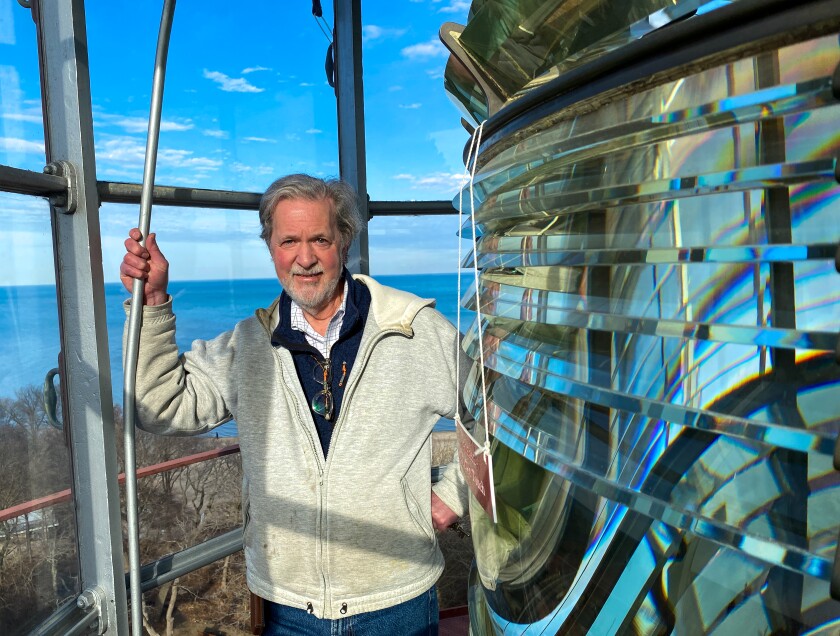
Terras, the longtime caretaker of the property and head of the Lighthouse Park District, also points out the lantern’s immense, second-order Fresnel lens.
“It’s the last one that operates on the Great Lakes,” he says.
The tower still functions as a private aid to navigation, and its surrounding beach area is a popular place to recreate. The facility’s museum, open during the weekends in the summer months, helps explain the direct role that lighthouses played in facilitating local growth and development.
Terras says it can be hard to picture today, but in the latter half of the 19th century, the area’s lakefront teemed with commercial maritime traffic.
“During many years in the 1800s, Chicago surpassed New York, San Francisco, New Orleans, all the major seaports, in arrivals and departures,” he says. “Chicago’s port, of course, because of winter, was only eight months long. The other ports had 12-month seasons.”
Each lighthouse’s distinct flash pattern helped all these ships and schooners safely navigate, and in the case of Grosse Point, to also warn of shallow waters or shoals.
Illinois’ lighthouses were a link, Terras says, to safely get material and people to the Midwest and beyond.
Restoring a beacon
The most prominent link on that chain is one you’ve probably walked by — one undergoing a push to preserve its cultural significance.
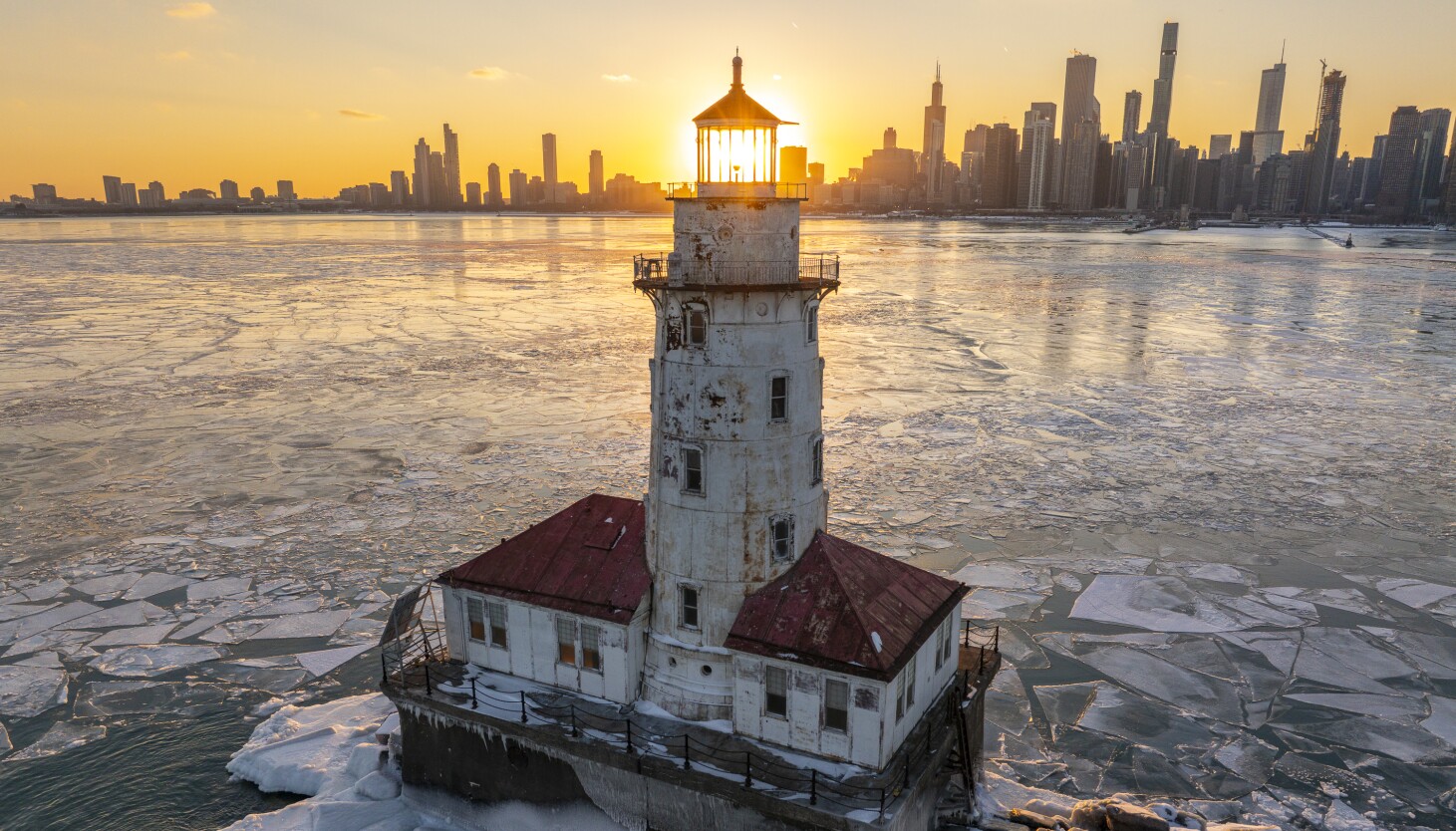
The Chicago Harbor Lighthouse is hidden in plain sight, resting in Lake Michigan at the extremity of the northern breakwater, about half a mile from the end of Navy Pier.
“Our biggest concern is that no one knows why it’s there or what it’s there for,” says Kurt Lentsch, who started the nonprofit Friends of the Chicago Harbor Lighthouse to bring it back to life. “It’s been in the background of our memories for our generation, for 100-plus years.”

The lighthouse was originally built in 1893 against the backdrop of the World’s Columbian Exposition. In 1917, officials decided to move it to its current location.
The Coast Guard operates the actual light as an active aid to navigation, but the station is in a state of disrepair. According to an assessment report, it’s rusted, crumbling and gutted.
Lentsch, a longtime recreational boater, was spurred to action in 2022 amid worries that the property could be put up for auction, potentially ending up in private hands.
He was determined to keep the historic landmark public. His volunteer organization is awaiting final approval to take over the property from the city of Chicago to repurpose it as an accessible visitor center. The group envisions it as an extension of the nearby Loop’s Museum Campus — a tourist attraction with a major focus on local education.

“The goal is to turn the museum into a classroom on the lakefront, to really teach kids programming out at the light — from a lighthouse perspective, from engineering, to weather, to water sampling,” Lentsch says.
The pending stewardship change is possible through the federal government’s National Historic Lighthouse Preservation Act of 2000, which has allowed local entities and nonprofits to commit to saving outdated light stations across the country.
Lentsch says helping the public better understand the area’s rich maritime heritage is a major reason why people want to save these beacons.
“It’s such an iconic part of the skyline,” he says. “It’s been there before most of those buildings were there.”

Challenges remain, like raising the estimated $6 million necessary for the project, but former Coast Guard lighthouse keepers Barton and Gach say the effort is worth it.
“I want people to go and visit it. Turn around, look at the city of Chicago and love the view that I loved,” Gach says.
Barton hopes visitors will take away an appreciation for those who literally lit the path to Chicago.
“There’s only a handful of people [that have] ever been on a lighthouse, let alone work it,” he says. “It was special.”
Katie Riordan is a journalist based in Chicago.

