

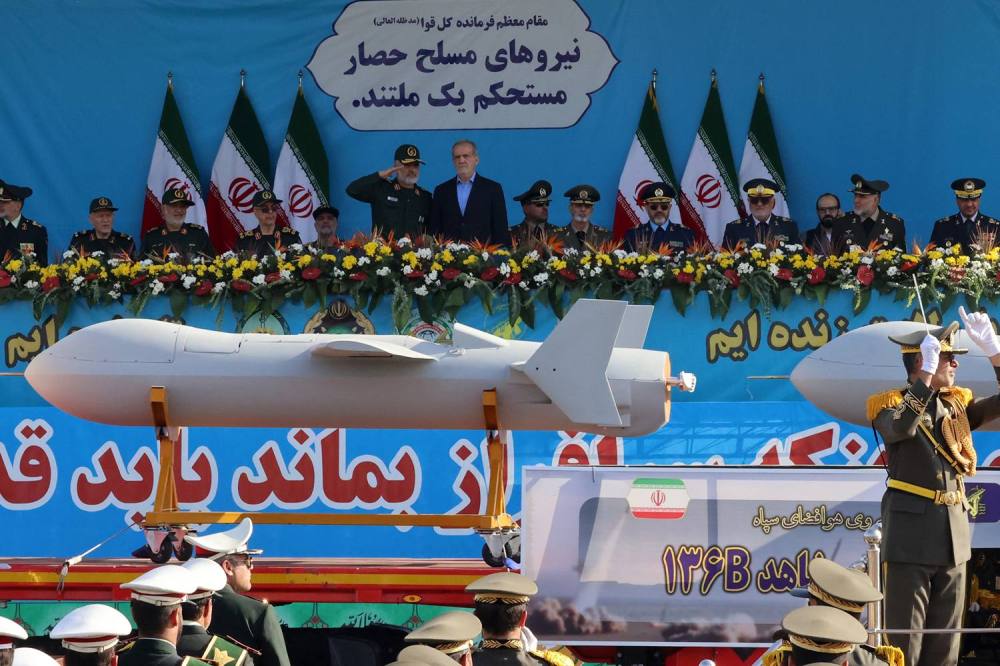
When a report emerged earlier this month that the FBI had alerted California police departments that Iran could launch drone attacks on the state from a vessel off the West Coast, it understandably raised anxiety among residents.
But the FBI’s warning, which was sent in late February, was based on unverified information. The White House quickly downplayed the notion that there was an Iranian drone threat to the homeland. On March 11, U.S. President Donald Trump told reporters that the tenuous drone plot was being “investigated,” but he also said that he wasn’t worried about Iran carrying out a domestic terrorist attack on U.S. soil. That same day, California Gov. Gavin Newsom said that drone issues “have always been top of mind” but that he wasn’t aware of any “imminent threats” to California.
More recently, unidentified drones have been detected flying over the military base where U.S. Secretary of State Marco Rubio and U.S. Defense Secretary Pete Hegseth live—and officials have reportedly considered relocating them amid concerns over the possibility of Iranian retaliatory attacks.
While there does not appear to be any firm intelligence pointing to an imminent Iranian drone attack on U.S. soil, experts warn that Washington still needs to be prepared for such threats. And even if Iran does not decide to take direct action against the U.S. homeland, its proxies or lone-wolf actors could use drones in an attack.
“The U.S. should very much be concerned about all possible contingencies. While flying planes into buildings was once the work of fiction, it happened in real life on Sept. 11, 2001,” said Colin Clarke, an international security expert and executive director of the Soufan Center. “The 9/11 Commission Report called the failure to prevent 9/11 a failure of imagination. So the same would apply to novel [unmanned aerial vehicle] threats that could impact the U.S. homeland.”
James Patton Rogers, an expert on drones at Cornell University, said that he’s been concerned that drones could be used in a “surprise attack” against the United States for years.
“We know the superpower of the drone is its ability to be deniable, remotely or autonomously operated, and it operates over great distances. … And we also know that drones are highly mobile,” Rogers said, noting that smaller systems can be kept in shipping containers, launched from out at sea, and travel up to some 1,200 miles.
The United States has interceptor squadrons and a large amount of naval assets on the West Coast, where this unverified threat was first reported, but “all of us have vulnerabilities,” Rogers said.
“If we’re talking about the general defense against some quadcopter systems that appear over a military base or some incoming one-way attack drones like a Shahed-136, [then] does the United States have the capabilities to defend against that? Yes, absolutely, as it has done time and time again in this current conflict against Iran,” Rogers said. “Does it have enough of the counterdrone capabilities and a depth of munitions to continue to defend against them? That I’m less certain about.”
Kate Bondar, a former advisor to the Ukrainian government who is now a fellow at the Center for Strategic and International Studies, a Washington think tank, said that when she first saw the news about possible Iranian drones in California, it seemed a “bit absurd.” But in terms of the “broader context of this threat, this is something that the United States has to think about,” she said.
“We’ve been watching for four years what’s going on in Ukraine, and the biggest issue with this new type of warfare, specifically drones and all sorts of unmanned systems across all domains, is that they are accessible, they’re very cheap, and they’re easy to produce by basically anyone,” Bondar said.
The Shahed-136, a relatively inexpensive and brutally effective long-range, one-way attack drone that has been referred to as the “poor man’s cruise missile,” is the most important drone in Iran’s arsenal. Iran fires these “kamikaze” drones in large numbers to overwhelm its enemy’s defenses—and if even just one gets through, the impact can be devastating and deadly. The Shahed-136 has a range of around 1,200 miles, a cruise speed of roughly 115 miles per hour, and can carry a warhead up to around 110 pounds. Shahed-type drones are easy to transport and can be launched from the back of a pickup truck (or ship).
The devastating capabilities of drones like the Shahed-136 have been on full display since the Iran war began on Feb. 28. Six U.S. soldiers were killed by an Iranian one-way attack drone that hit a tactical operations center in Kuwait on the second day of the war. This marked the deadliest incident in the war for the United States so far. More than 230 U.S. service members have also been injured in the war. Joint Chiefs of Staff Chairman Gen. Dan Caine said in mid-March that a majority of the injuries could be attributed to strikes by one-way attack drones.
Drones launched by Iran and its proxies have also penetrated allied defenses in the region, hit U.S. military installations and embassies, struck vessels in the Strait of Hormuz, and slammed into buildings in civilian areas across the Gulf. The situation should also serve as a warning in relation to homeland defense. Rogers said that even Israel’s sophisticated Iron Dome system has faced challenges countering some Iranian drones.
“If that’s the world’s most advanced air defense system, then it shows that all of us have vulnerabilities,” Rogers said.
Shahed-136 drones lack the range to be launched from Iran to hit the United States, but they could theoretically be launched from a ship to overcome that. “By their nature, the Iranians have to approach the U.S. asymmetrically, so while I think something like this would be incredibly difficult to pull off, it’s not impossible to conceive,” Clarke said.
Though Shaheds have proven to be a potent weapon in Iran’s arsenal, experts tend to think there’s a higher probability that commercially available drones would be used in a hypothetical attack on U.S. soil—and any such incident wouldn’t necessarily involve Iran directly.
“A more likely avenue for a domestic terror attack could be an Iranian-directed or Iranian-inspired attack using a commercial off-the-shelf drone in an urban setting or against a soft target. The resources required to execute an attack like this are minimal, and the skills aren’t hard to obtain,” Clarke said.
Similarly, Bondar emphasized that first-person view drones can be purchased on Amazon and modified to carry explosives. “Basically anyone can do it,” Bondar said. “This threat is really underestimated.”
That said, the United States has not experienced any state-sponsored attacks or attempted attacks explicitly linked to Iran since the war began on Feb. 28. And experts believe that an attack on the U.S. homeland is not currently a major priority for Tehran given its success in cutting off the Strait of Hormuz, which has caused global oil prices to skyrocket and placed Trump in an uncomfortable position politically and economically.
Iran believes it has a “winning strategy right now” by putting pressure on the Strait of Hormuz, through which 20 percent of the world’s crude oil and liquefied natural gas flows, said Alex Plitsas, a former U.S. Defense Department official who is now a senior fellow at the Atlantic Council. Tehran believes “they’re going to pressure President Trump into stopping the operation because they’re convinced he’s concerned” about the war’s potentially negative impact on Republicans in the upcoming midterm elections in November.
The Iranian regime also has backup options that it can lean on before moving up the escalatory ladder to an attack on the U.S. homeland, Plitsas said, including seeing the Houthis in Yemen attempt to cut off the Bab el-Mandeb Strait, another crucial shipping route on the other side of the Arabian Peninsula. The Houthis have not yet joined the war, but they are being closely watched by the United States and its allies after having already demonstrated their ability to wreak havoc on shipping in the Red Sea.
Plitsas underscored that while Iran is a “rational actor,” it could still move to additional asymmetric threats, including transnational terrorism, if it feels backed into a corner at a future point in the war. But even if Iran does go down that road, drones are not necessarily the first option in the toolkit that Tehran would reach for. Iran would probably attempt to do something “more spectacular” than a drone attack to have an impact, Plitsas said, such as an assassination.
Over the years, Iran has covertly sent intelligence officers into the United States to “map targets for potential future attacks” and has attempted to recruit people in murder-for-hire or assassination plots—including an alleged plot targeting Trump—and it has a well-known history of links to transnational terrorism through proxy groups like Hezbollah, Plitsas said. Relatedly, questions have been raised about whether Iran could activate so-called “sleeper cells” of operatives in the United States, which Trump recently said the government is carefully monitoring.
Plitsas also said it’s possible that there could be lone-wolf incidents in which an individual responding to the conflict with Iran decides to take matters in their own hands. On March 1, a man wearing a sweatshirt that said “Property of Allah”—as well as what authorities said was a shirt underneath that featured an Iranian flag design—carried out a mass shooting at a bar in Austin, Texas. The incident, which left three dead (including the shooter) and wounded more than a dozen, is being investigated as a potential act of terrorism. The shooting ignited concerns over domestic blowback tied to the Iran war.
So far, Iran has “very deliberately climbed up the escalation ladder,” Clarke said. It could be the case that Islamic Revolutionary Guard Corps hard-liners view an “attack on the U.S. homeland as a measure of last resort, but one that they would be willing to operationalize if they felt the need to do so,” Clarke said, adding that a “U.S. ground operation could very well be that tripwire for the Iranians.”
It’s difficult to predict what will happen next in the escalating U.S.-Israel-Iran war. Trump has claimed that talks to end the fighting have begun between the United States and Iran, which Tehran has denied. Meanwhile, the United States is moving more military assets, including thousands of Marines, to the region—raising speculation that it could soon have boots on the ground in Iran for the first time since the war began.

