
Welcome back to World Brief, where we’re looking at indirect nuclear talks between the United States and Iran, new Canadian and French consulates in Greenland, and a brazen attack on a deputy chief of Russia’s military intelligence agency.
Mistrust on Both Sides
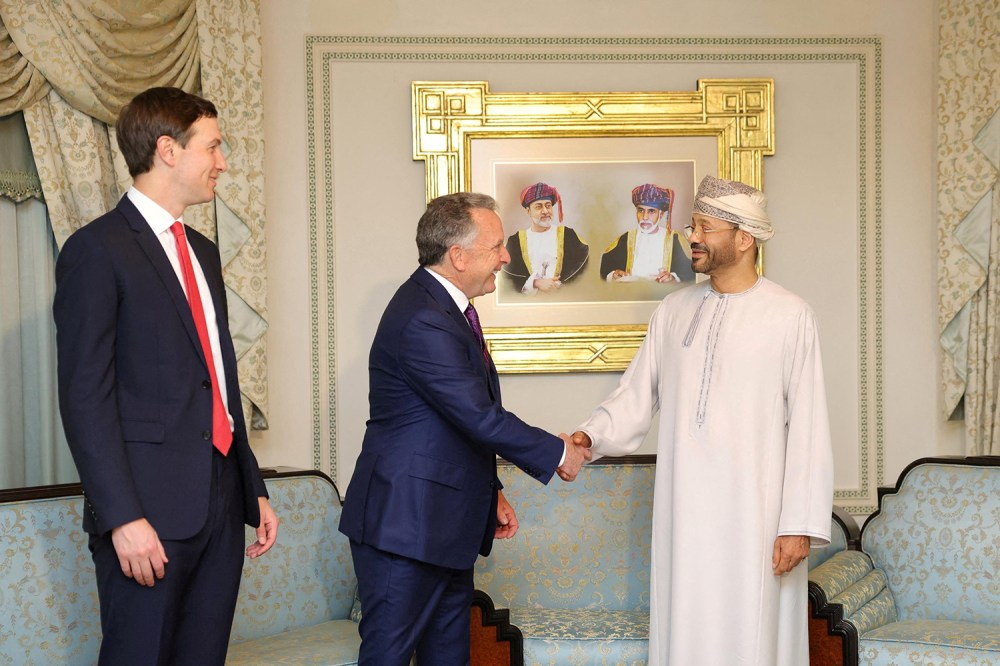
U.S. and Iranian officials held indirect talks in Muscat, Oman, on Friday—signaling the potential restart of nuclear negotiations amid rising tensions between the adversaries. The meeting marked the two sides’ first formal diplomatic discussions since U.S. President Donald Trump ordered strikes on Iranian nuclear sites in June 2025 during the 12-day Israel-Iran war.
The meeting was initially planned to be held in Turkey, with foreign ministers from Turkey, Egypt, Qatar, and Saudi Arabia also set to attend. But Iran successfully pushed to move the venue to Muscat and to exclude representatives from those other countries. Axios reported that, according to two unnamed sources, U.S. and Iranian officials met directly during the talks. The White House and State Department did not immediately respond to Foreign Policy’s requests for comment.
Talks are off to a “good start,” Iranian Foreign Minister Abbas Araghchi said on Friday, adding that consultations regarding next steps must now be held in Washington and Tehran. However, Araghchi also warned that “mistrust” between the two countries is posing a “serious challenge” to negotiations.
“We did note that nuclear talks and the resolution of the main issues must take place in a calm atmosphere, without tension and without threats,” he said. “The prerequisite for any dialogue is refraining from threats and pressure.”
Restraint may be difficult to come by. For the first time, the United States brought its top military commander in the Middle East to the negotiating table. The participation of U.S. Navy Adm. Brad Cooper, the head of the U.S. Central Command, served as a stark reminder of Washington’s military presence in the region.
Trump has repeatedly threatened to use force to compel Tehran to reach a nuclear deal. Late last month, the U.S. president deployed the USS Abraham Lincoln and other warships to the Arabian Sea in response to Iran’s weekslong bloody crackdown on anti-government protesters; estimates place the number of demonstrators killed between roughly 6,000 people and more than 33,000 people. On Tuesday, a U.S. Navy fighter jet shot down an Iranian drone near the Abraham Lincoln, the same day that Iranian forces tried to stop a U.S.-flagged oil tanker in the Strait of Hormuz.
“Bad things” will likely happen if Washington and Tehran are unable to reach a deal, Trump has warned, adding on Wednesday that Iranian Supreme Leader Ayatollah Ali Khamenei should be “very worried.” Iran is reportedly concerned that a U.S. attack could reignite the country’s protest movement and threaten the regime’s survival. And neighboring Arab nations in the Gulf remain fearful that such an assault could spark all-out regional war.
To avoid this, experts are hoping that U.S. and Iranian negotiators can reach a nuclear deal; however, a limited agenda may provide significant obstacles. Tehran maintains that dialogue must only center on its nuclear program, stressing that discussions on ending its uranium enrichment program or shipping its uranium abroad are nonstarters. Yet, U.S. Secretary of State Marco Rubio said on Wednesday that Washington wants to expand the conversation to include Iran’s ballistic missile program, its support for armed groups in the region, and the Iranians’ “treatment of their own people.”
Friday’s talks were “useful to clarify both Iranian and American thinking and identify areas for possible progress,” Omani Foreign Minister Badr al-Busaidi said.
The White House has not yet issued a statement on the talks in Muscat. However, also on Friday, the U.S. State Department announced new sanctions on Iranian entities, vessels, and individuals allegedly tied to Tehran’s so-called shadow fleet, which Washington accuses of helping Iran evade sanctions on its oil industry.
Today’s Most Read
What We’re Following
Show of solidarity. Canada and France opened consulates in Nuuk, Greenland, on Friday to signal a united front with the semi-autonomous Danish territory. Ottawa had already pledged to open a consulate in Greenland in 2024 but was postponed from formally inaugurating it in November 2025 due to bad weather. However, Paris only recently agreed to do so following French President Emmanuel Macron’s visit to the island in June; France is the first European Union member to establish a consulate general in Greenland.
The opening of new consulates is a thinly veiled response to Trump’s Greenland ambitions. Since taking office in January 2025, Trump has threatened to acquire the island, arguing that it is vital to U.S. national security despite the Danish territory being part of NATO. Last month, Trump claimed to have reached a deal with NATO chief Mark Rutte to give the United States total and permanent access to Greenland, even though Washington already had extensive access to the island.
Still, Trump’s actions have worried Greenlanders, of whom more than 75 percent do not wish to become part of the United States. “It’s really important for us to know that we are not alone in this, that we actually have people from other countries who care about us,” said Avaaraq Olsen, the mayor of the district that includes the capital, Nuuk.
Possible assassination attempt. An unidentified assailant shot and severely wounded a deputy chief of Russia’s military intelligence agency on Friday. According to Russian Investigative Committee spokesperson Svetlana Petrenko, Lt. Gen. Vladimir Alekseyev has been hospitalized after being shot several times at an apartment building in Moscow.
Russian authorities immediately blamed Ukraine, without citing evidence. Kyiv is believed to have previously carried out assassinations on high-level Russian officials. However, some Russian commentators have suggested that Alekseyev had enemies inside Russia. Ukraine has not yet issued a comment.
The attack comes just one day after a second round of U.S.-brokered Russia-Ukraine peace talks wrapped in Abu Dhabi, the United Arab Emirates. Although the meetings ended with the U.S. European Command agreeing to reopen military-to-military communications with Moscow, no breakthroughs emerged to end the nearly four-year conflict.
“This terrorist act once again confirmed the Zelensky regime’s commitment to constant provocations aimed at disrupting the negotiating process,” Russian Foreign Minister Sergey Lavrov said, referring to the Alekseyev shooting. The Kremlin has placed the onus of progress on Kyiv, demanding that Ukraine relinquish large swaths of territory to Russia.
Takaichi’s litmus test. Trump formally endorsed Japanese Prime Minister Sanae Takaichi on Thursday ahead of snap parliamentary elections this weekend. Takaichi “has already proven to be a strong, powerful, and wise Leader, and one that truly loves her Country,” Trump wrote on Truth Social, offering his “Complete and Total Endorsement.” Trump is expected to host Takaichi at the White House on March 19.
Opinion polls predict big wins on Sunday for Takaichi and her ruling coalition, which seeks to increase defense spending to counter Chinese threats in the Indo-Pacific; just one month after taking office in October 2025, Takaichi characterized a possible future Chinese attack on Taiwan as a “survival-threatening situation” that could permit Japan to take military action—sparking a slew of retaliatory measures from Beijing. Takaichi has not backed down, despite Trump reportedly telling her during a private phone call in November not to further aggravate Beijing.
If Takaichi’s conservative Liberal Democratic Party secures a majority in parliament, then she may begin to receive support from global investors, who have remained largely spooked by her fiscal policies up to this point.
What in the World?
The United States on Tuesday confirmed that it had dispatched troops to Nigeria, following a December 2025 airstrike on the country that Washington said targeted members of which jihadi organization?
A. Ansar al-Dine
B. Islamic State
C. Boko Haram
D. Al-Shabab
Odds and Ends
The 2026 Winter Olympics kicked off in Milan and Cortina, Italy, on Friday. But before (most of) the competitions can begin, the Olympic torch must first be lit. Passing of the flame began on Nov. 26, 2025, from the Games’ birthplace (Olympia, Greece) before traveling through all 110 Italian provinces and landing in San Siro Stadium in Milan. Notable carriers included Heated Rivalry actors Hudson Williams and Connor Storrie, K-pop star Sunghoon, Italian director Giuseppe Tornatore, and U.S. chef Nick DiGiovanni.
And the Answer Is…
B. Islamic State
Despite descriptions by U.S. officials of Africa being “peripheral” to American interests, officials from African countries, including Nigeria, attended a critical minerals summit in Washington this week as part of the White House’s effort to dismantle China’s dominance of the industry, FP’s Nosmot Gbadamosi writes in Africa Brief.
To take the rest of FP’s weekly international news quiz, click here, or sign up to be alerted when a new one is published.

