
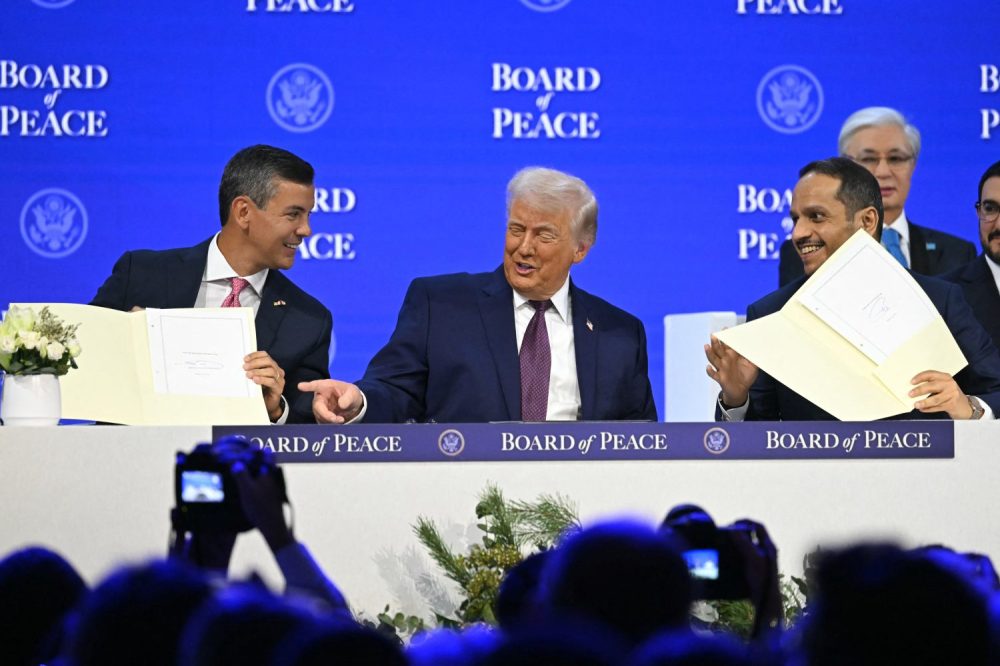
U.S. President Donald Trump’s launch of the Board of Peace at the World Economic Forum in Davos, Switzerland, last week has been condemned as an imperial project and mocked for the motley crew that it attracted. Yet the derision cannot mask the geopolitical audacity of the initiative. Whether or not it succeeds, Trump’s Board of Peace already amounts to the most sweeping attempt to modify—if not supplant—the global order established in 1945. Unlike the many rhetorical assaults on the United Nations over the decades, Trump has produced a format and potential institution that could one day rival the U.N.
The Board of Peace began as a mechanism with a limited mandate to promote peace and reconstruction in Gaza following its pummeling by Israel after the brutal Hamas attack of October 2023. Last November, U.N. Security Council Resolution 2803 authorized Trump personally to lead this board. Trump has boldly expanded that mandate to cover peace and security beyond Gaza. He has not bothered to deny the growing accusations that his real goal is to marginalize the Security Council itself.
Given the sweeping ambition of Trump’s board, one might have expected the BRICS forum—the self-appointed vanguard of anti-hegemonic politics and the champion of the global south—to rain fire on the U.S. president. But the BRICS turned out to be the lion that did not roar. Instead of confronting Trump, many of its members and aspirants have facilitated his project by either quietly joining or looking the other way.
The Board of Peace is structured around a powerful executive chair—Trump himself—with control over its membership and veto power over its policies. He holds this position for life, not just qua the U.S. presidential office. The board also provides for a tiered membership system. Normal membership lasts for three years; a permanent seat can be bought for $1 billion.
Trump invited nearly 60 countries at the Davos launch; about 25—including Indonesia, Saudi Arabia, Egypt, Jordan, Turkey, Pakistan, Qatar, and the United Arab Emirates—have signed on. A handful of European outliers—Hungary, Bulgaria, and Belarus—also embraced the board. The presence of Egypt, Indonesia, and the UAE—three new BRICS+ members—was striking. Saudi Arabia, an invitee to BRICS but not yet a formal member, joined as well. Argentina, which rejected BRICS membership under President Javier Milei, turned up at Davos to align itself with Trump’s new order.
Among the original BRICS members, South Africa was not invited. Brazilian President Luiz Inácio Lula da Silva rejected Trump’s invitation, calling the board an attempt “to create a new U.N. in which he, alone, is the owner.” Lula called Chinese President Xi Jinping and Indian Prime Minister Narendra Modi, urging tighter BRICS coordination and warning that Trump’s board “threatens multipolarity and institutional multilateralism.” Lula’s activism underscored Brazil’s discomfort, but he failed to produce a united BRICS response.
China, too, offered ritual criticism but avoided escalation. A Foreign Ministry spokesperson said that “China will firmly safeguard the international system with the U.N. at its core.” The tone was unusually mild, reflecting China’s reluctance to provoke Trump at a moment of tariff pressure and pending trade negotiations.
India, for its part, neither accepted nor rejected the invitation. Delhi has enough problems with Trump—from tariffs to his meddling in the conflict with Islamabad—and sees no value in publicly antagonizing him. Yet Prime Minister Narendra Modi had strong reasons to stay out. Had the board remained limited to Gaza, he might have found room to participate. But once Trump expanded the mandate to global peace and conflict resolution, India worried—reasonably—that it might one day find itself the target of Trump’s activism.
This concern is not about Kashmir per se. It stems from Trump’s own repeated claims that he stopped the India-Pakistan war in May 2025 and his reported eagerness to promote a grand peace between New Delhi and Islamabad. The Indian political class is all but united in rejecting external mediation—let alone by Trump—to resolve its conflict with Pakistan.
Russia’s reaction was the most curious. President Vladimir Putin said that Moscow would “study” the proposal and “consult with our strategic partners,” adding that Russia could contribute $1 billion in frozen Russian assets to the new board—a remark interpreted as feigned interest rather than enthusiasm. But there is no mistaking Putin’s reluctance to challenge Trump’s attempt to undermine the U.N. This must be rather painful for Putin, who views Russia’s role in building the post-World War II order with the United States and centered around the United Nations as sacred.
Even stranger was the decision of Belarus—Moscow’s closest ally—to join the board. Whether President Aleksandr Lukashenko secured the Kremlin’s quiet acquiescence or acted independently remains unclear. Vietnam, another unexpected signatory, reflects yet another pattern. A communist state close to both Russia and China, Vietnam has accumulated a massive trade surplus with the United States and is desperate to avoid becoming a target of Trump’s tariff diplomacy.
In Asia, most U.S. allies—including Japan, South Korea, and Australia—stayed away. But Indonesia, long a leading voice of the Non-Aligned Movement and the anchor of the Association of Southeast Asian Nations, became an enthusiastic early backer. Indonesian President Prabowo Subianto defended joining the board by invoking its original purpose of bringing peace to the people of Gaza. Prabowo also insisted that sitting alongside Israel in a conflict-resolution body was necessary to secure relief and reconstruction. His remarks signaled Jakarta’s pragmatic shift from ideologically driven postures on the Palestinians in the past to transactional alignment with Washington.
Indonesia’s flip was part of the broader pattern in the parts of the Islamic world that actively facilitated Trump’s Board of Peace. In September 2025, a joint declaration by Saudi Arabia, Turkey, the UAE, Egypt, Jordan, Qatar, Indonesia, and Pakistan signaled an extraordinary shift. In the statement, their leaders affirmed “their commitment to cooperate with President Trump, and stressed the importance of his leadership to end the war and open horizons for a just and lasting peace.” It represents an acknowledgment that neither the U.N.’s efforts nor the Islamic world’s ritualized expressions of support have come close to delivering results.
By legitimizing U.S.-led conflict-management structures, this declaration by Islamic countries paved the political ground for the Security Council to approve Trump’s Board of Peace in November. Resolution 2803 authorized Trump to coordinate Gaza’s cease-fire, relief delivery, and reconstruction through a special international mechanism reporting to the Security Council. It granted him broad latitude to appoint teams, raise funds, and engage regional actors. Although framed as temporary, the resolution effectively outsourced U.N. authority to a single individual.
The resolution passed unanimously—its significance buried in the diplomatic niceties. Russia and China abstained, enabling the resolution without endorsing it. Britain and France voted for it. Europe’s nonpermanent members at the time—Denmark, Greece, Slovenia—also supported it. Yet none of them signed the board charter in Davos. The Europeans had clearly misjudged Washington’s plans for the board beyond the Gaza issue.
The nonpermanent non-Western countries in the Security Council—Algeria, Guyana, Pakistan, Panama, Sierra Leone, Somalia, and South Korea—also voted in favor. Most said they did so out of humanitarian urgency. Whatever their motivations, the moment may well be remembered as the first time that the Security Council ceded its core mandate—peace and security in the world—to one man.
Could this become the Security Council’s obituary? Trump’s U.N. mandate expires at the end of 2027. Russia and China may veto any renewal, but by then, the board might have acquired institutional momentum, alternative legitimacy, and financial autonomy. And long before that, it has exposed the fragility of several assumptions that are fashionable in global politics.
First, the so-called global south—supposedly united in anger at Israel’s campaign in Gaza—ended up supporting a resolution that removed pressure on Israel and gave Palestinians little say in governing Gaza’s future. When forced to choose between moral posturing and geopolitical access, the leading states of the global south opted for influence within a U.S.-led structure.
Second, the BRICS—celebrated as the vanguard of the post-American global order—has been unable to prevent its members from backing Trump’s new organization, which violates many of BRICS’ core principles. The bloc’s 2024-25 expansion, widely hailed as transformative, has instead accelerated incoherence. Far from counterbalancing the United States, the expanded BRICS has revealed itself as a loose and shaky coalition of states with divergent priorities and overlapping vulnerabilities. If these states have one thing in common, it is the importance they attach to continued bilateral engagement with Washington.
Finally, Trump’s Board of Peace underscores a deeper truth: The global order is shaped not by slogans of solidarity or pious praise of multilateralism, but by the calculus of national interest. Whatever one might think of Trump’s rough and ready methods, he has shown the capacity to break out of past paradigms.
The prospects for the Board of Peace depend on Trump’s political fortunes and the durability of his impact on U.S. foreign and security policies. But one thing is already clear: The myth of a united global south resisting U.S. hegemony under China’s and Russia’s leadership has melted away in Davos. And the BRICS wall, hailed as the bulwark against U.S. hegemony, is revealing major cracks.

