
Shortly after taking office in January, U.S. Secretary of State Marco Rubio pledged to carry out what he called an “Americas First” foreign policy. “U.S. foreign policy has long focused on other regions while overlooking our own,” he wrote in a Wall Street Journal op-ed. “That ends now.”
Rubio’s first official trip in February took him to five Latin American and Caribbean nations. Since then, nonstop attention from U.S. President Donald Trump has injected further unpredictability into a region where politics were already volatile. Some ideologically aligned leaders, such as in Argentina and El Salvador, have bought into the MAGA vision—striking shady deals with the United States that have come under scrutiny from Democrats.
The Trump administration has wielded U.S. economic and military might to try and extract concessions from other countries that don’t toe its line. This month, the White House marked the anniversary of the Monroe Doctrine by adding a “Trump corollary” that emphasizes U.S. “control” over the Western Hemisphere.
In January, Colombian President Gustavo Petro reneged on a pledge not to accept U.S. deportation flights after Trump threatened punitive tariffs on his country—the biggest exporter of cut flowers to the United States. After Rubio’s visit in February, Panama quickly caved to U.S. demands that a Hong Kong-based firm relinquish its stake in two Panama Canal ports.
Other countries have put up more resistance. In the face of unprecedented U.S. meddling in the Brazilian justice system, authorities held strong and convicted former President Jair Bolsonaro of plotting a coup. By diversifying its trading partners, Brazil’s economy—South America’s largest—appears poised to weather one of the highest U.S. tariff rates in the world.
No action has jolted the region more this year than the U.S. military strikes on boats in the Caribbean, which began in September. The Trump administration said that it is targeting suspected drug smugglers, but it has not provided evidence or received authorization from Congress.
Many analysts suspect that the attacks, which have so far killed more than 100 people, may be a prelude to U.S. efforts at regime change in Venezuela. Leaders who had mended ties with Washington now find themselves in a bind over whether to speak out. Petro and his family were swiftly hit with U.S. sanctions after he called the strikes “murder.”
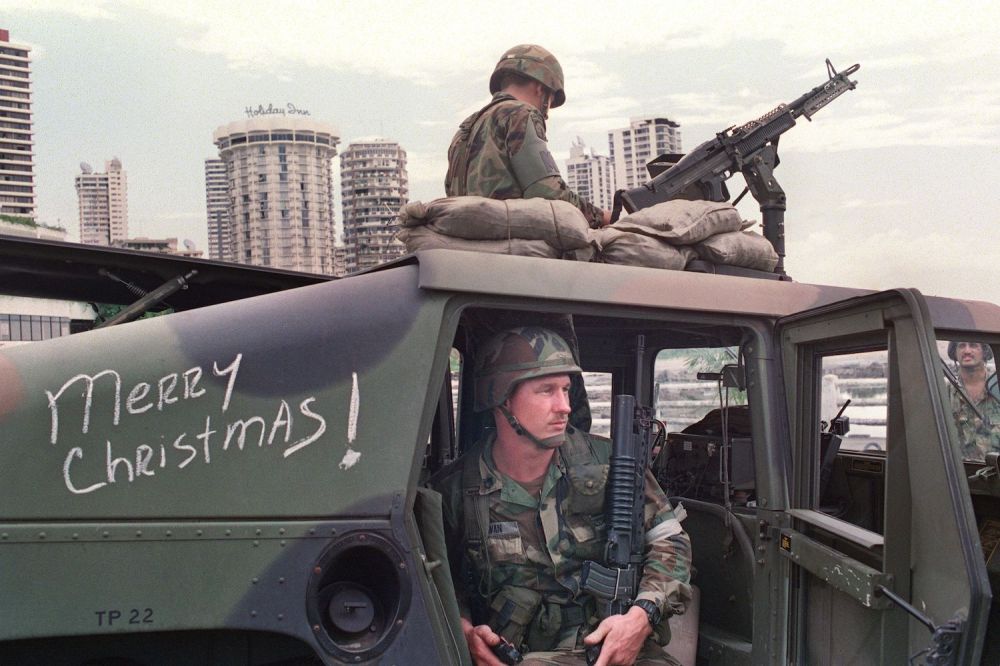
All eyes are now on Caracas, where Venezuela’s Nobel Peace Prize-winning opposition leader has voiced support for what she calls Trump’s “war.” Officials in Washington have reportedly alluded to the 1989 U.S. invasion of Panama as a model for military action in Venezuela; that operation took place over Christmas.
While the world watches and waits, here are five of Foreign Policy’s best reads on Latin America’s turbulent year.
1. Panama Isn’t Surprised by Trump’s Imperial Fixation
By Christina Guevara, Feb. 5
Since his inauguration, Trump has displayed an “imperial fixation” with Panama, Christina Guevara writes. “We gave it to Panama, and we’re taking it back,” Trump said of the Panama Canal, falsely claiming that China controls the waterway.
In reality, the United States has “conflated—intentionally or unintentionally—Chinese companies operating nearby ports with Chinese control of the canal itself,” Guevara writes. On his trip to Panama in February, Rubio threatened U.S. action if Hong Kong conglomerate CK Hutchison did not sell its majority share in two ports. The company acquiesced a month later.
The saga was “all too familiar to Panamanians,” who have endured a long history of U.S. intervention, Guevara writes. Today, they “are steadfast in their determination to protect the canal.”
2. The Horror Inside the Salvadoran Prisons Where Trump Is Sending Migrants
By Noah Bullock, March 20
Rubio’s February trip also included a stop in El Salvador. Whereas his visit to Panama involved threats and coercion, Rubio’s sojourn in El Salvador was chummy: Autocratic Salvadoran President Nayib Bukele has fashioned himself a close Trump ally and sought to ingratiate himself with the administration.
Bukele suggested that El Salvador detain migrants deported from the United States, an offer that Rubio called an “extraordinary gesture.” Bukele has made mass incarceration the cornerstone of his agenda, opening the world’s largest prison in 2023. In the weeks and months that followed, the White House defied a judge’s orders to send planeloads of migrants to the small Central American nation, which it reportedly paid $6 million.
“The American people must be clear-eyed about the prison system to which their government is sending deported migrants—which, in the worst-case scenario, could one day hold U.S. citizens, too,” writes Noah Bullock, the executive director of Cristosal, a Central American human rights group. Bullock’s organization has spent years documenting abuses in El Salvador, which he lays out in a chilling piece.
3. Brazil’s Historic Conviction
By Oliver Stuenkel, Sept. 12
Students demonstrate next to a giant inflatable doll depicting former Brazilian President Jair Bolsonaro dressed as prisoner a day after after Brazil’s Supreme Court sentenced him to 27 years in prison for coup plotting, seen in Brasília, Brazil, on Sept. 12.Pablo Porciuncula/AFP via Getty Images
In September, Brazil’s Supreme Court convicted Bolsonaro and seven associates of plotting a coup, sentencing the former president to 27 years in prison. It was a “turning point” for the country, which has experienced many coups—and coup attempts—throughout its history but rarely punished those who masterminded them, according to Oliver Stuenkel.
“This should be welcome news for Brazilian democracy, but the story is far from over,” Stuenkel writes. “Bolsonaro’s conviction raises major domestic and foreign-policy challenges for the country.”
Bolsonaro’s trial occurred amid a U.S. intimidation campaign that sought to absolve the former leader, a Trump ally. The United States imposed sanctions on a Brazilian Supreme Court justice and increased tariffs on Brazilian goods. But Brazilian President Luiz Inácio Lula da Silva refused to back down, defiantly stating that “no gringo will dictate to this president.” Lula has made the defense of Brazil’s sovereignty a key part of his platform ahead of next year’s elections.
U.S. pressure aside, the proceedings have polarized Brazil. Polls show that a slight majority of Brazilians do not trust the Supreme Court, a divide that largely falls along political lines. Even with Bolsonaro now in prison, “Brazil’s democracy cannot stabilize if a large portion of its political class continues to regard the judiciary’s rulings as illegitimate,” Stuenkel writes.
4. Why Is Trump Bailing Out Argentina’s Milei?
By Keith Johnson, Oct. 1
In neighboring Argentina, right-wing President Javier Milei is enjoying a very different relationship with the Trump administration. This fall, the United States promised Argentina a $20 billion economic lifeline if Milei’s party prevailed in midterm elections.
Although the United States has bailed out Latin American countries before—such as Mexico in 1995—it’s hard to make the case that Argentina’s largely closed economy is of similar “systemic interest” to the United States, FP’s Keith Johnson writes. Instead, many economists and politicians assume that the U.S. aid to Buenos Aires is “purely political.”
“Milei was a Trump favorite even before he was elected,” Johnson writes. Along with Bukele, Milei has also become a mainstay at the U.S. Conservative Political Action Conference, where this year he gifted a gilded chainsaw to Elon Musk.
“The contrast between the Trump administration’s approach to Argentina and Brazil is illustrative” of how politicized U.S. assistance has become, Johnson adds. Heavily tariffed Brazil is among the world’s largest economies and trades almost five times more with the United States on an annual basis than Argentina.
5. The Nostalgic Delusion of 1989
By Carlos Ruiz-Hernández, Nov. 11
As the United States continues its pressure campaign against Venezuela, members of Trump’s inner circle have reportedly alluded to the 1989 U.S. invasion of Panama as a potential model for regime change. That comparison may be “seductive,” but it is “fundamentally flawed,” argues Carlos Ruiz-Hernández, Panama’s former vice minister of foreign affairs.
The United States “has no forward presence, no in-country basing, no treaty rights, and no comparable intelligence infrastructure” in Venezuela, as it did in Panama, Ruiz-Hernández writes. Venezuela’s vast, rugged terrain also poses a strategic challenge. The country is “twice the size of Iraq, which consumed U.S. forces in counterinsurgency for nearly a decade.”
Geopolitics have changed, too. In 1989, at the end of the Cold War, “the United States faced minimal international blowback to its invasion of Panama,” Ruiz-Hernández writes. But today, U.S. imperialism plays firmly into the hands of adversaries such as China and Russia.
Despite making little logical sense, the “Panama analogy persists because it’s emotionally satisfying for U.S. hawks: swift action, minimal cost, moral clarity,” Ruiz-Hernández writes. “But Washington cannot invade its way to desired outcomes in Caracas.”

