
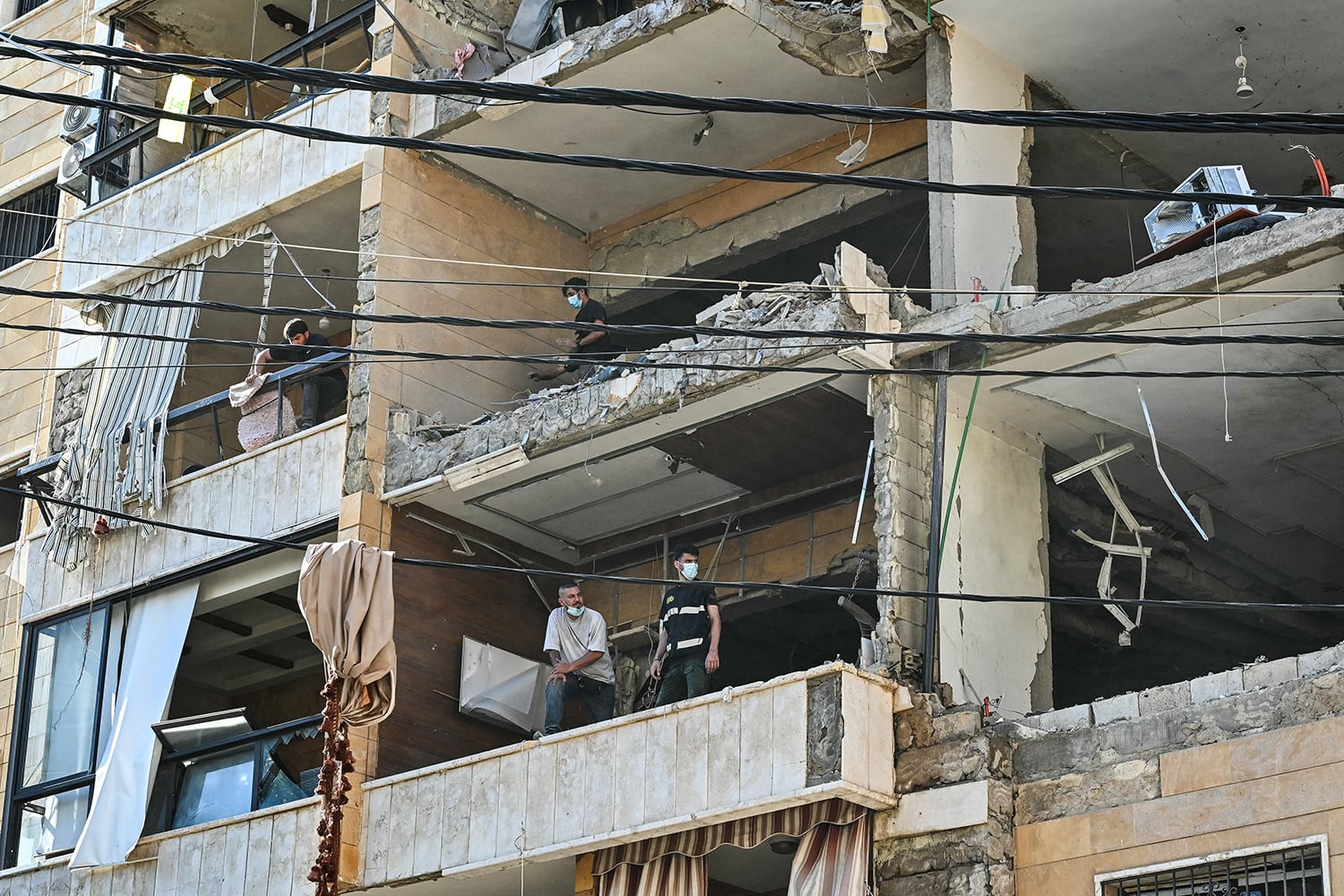
BEIRUT—The building in Beirut’s southern suburb had already learned the language of war. When I went to see it on Sunday, after the latest Israeli strike, it was not the image of sudden destruction that stayed with me, but the sense of repetition. Two floors had been hit. Two people were killed. The concrete carried older wounds from previous attacks in recent weeks, as if the target had not been newly identified but revisited. There are strikes meant to erase, and there are strikes meant to mark. This one felt like the second kind. A building left standing enough to speak, damaged enough to carry a message.
The Israeli account said the strike came after two Hezbollah rockets were launched toward northern Israel. The logic was familiar, and in the language of this war, almost routine: retaliation calibrated not only to punish but to signal. Yet what Israel appeared to be signaling went beyond Hezbollah. It was saying that the Lebanese front would be contained inside Lebanese geography, that any attack on Lebanon would not automatically open the Iranian file. Strike Lebanon, absorb the answer in Lebanon. That was the equation Israel wanted to impose, and the building in Dahiyeh was asked to carry it.
But war has a way of humiliating equations. Iran responded directly to the strike on Dahiyeh. Not to an attack on Iranian soil. Not to the killing of Iranian officers. Not to a strike on an Iranian facility. It responded to an Israeli attack in Lebanon. That detail matters, because it shifted the grammar of the confrontation. Tehran was no longer merely preserving deterrence after blows against itself; it was moving toward something closer to the active defense of its Lebanese flank. The strike Israel launched to deny the unity of fronts became the episode Iran used to demonstrate that unity. The message backfired into the very argument it was designed to refute.
An Israeli Iron Dome missile streaks across the sky to intercept incoming projectiles on June 8. Jalaa Marey /AFP via Getty Images
This is how a new equation often appears in the Middle East: not as a doctrine read from a podium, but as an action whose meaning becomes clear only after the smoke rises. The assumption that the war on Iran had pushed Tehran into caution did not survive the weekend. The Iran that emerged from that war has not behaved like a power weakened into restraint. The closure of the Strait of Hormuz continues. The diplomatic confrontation with Washington continues. And now Tehran has added another layer: Lebanese flash points can trigger Iranian action, even when Iranian territory itself is not struck.
Washington understood the danger quickly. U.S. President Donald Trump moved to urge Israel to limit or halt its retaliation, a sign that the U.S. calculation, at least for now, does not favor a wider escalation. Whether that restraint survives another round is a different question. But the request itself confirmed what the exchange had already made visible: The old frameworks through which Washington, Tehran, Beirut, and Tel Aviv once managed the Iran-Lebanon-Israel triangle have been overtaken by the war they were supposed to contain.

A child plays in front of a monument at Martyrs’ Square in Beirut on April 14. Elif Ozturk/Anadolu via Getty Images
Hezbollah parliamentarian Hussein Hajj Hassan received me in his office with the calm of a man who had already made peace with his conclusion. The Lebanese government, he said, was moving toward a deal with Israel worse than anything Lebanon had previously accepted. His movement would reject it. It would fail. He said this without heat, and that absence of heat was what stayed with me. It was not the performance of defiance. It was the composure of someone who believed the confrontation had already moved beyond persuasion.
Outside, Beirut’s Parliament Square looked like another country. A bride in a white gown posed for photographs near the entrance. A few meters away, a graduate stood with her parents, her cap slightly crooked, all three smiling into a camera as if history had granted them a brief exemption. Near the old clock, a band was rehearsing for a concert, with around a hundred empty chairs waiting for an audience that had not yet arrived. People drifted across the square unhurriedly, each absorbed in their own small life. Above them, an Israeli drone circled. Nobody looked up.
A few kilometers from that square, tens of thousands of Lebanese displaced by the war are living in tents. Close to 10 percent of the country’s territory is under Israeli occupation. The fragile internal fabric that held Lebanon together, never comfortably and never completely, is tearing in ways many here have not seen since the years before 1975. Some say this moment feels worse. The conditions are different, they argue, but the direction is familiar. What is striking is that none of this was visible in the square. That invisibility was not denial exactly. It was something more Lebanese than denial: a country conducting two realities at once, one on the surface, one underneath, with the distance between them narrowing by the day.
In April, writing from Tehran on the day Iran’s cease-fire was announced, I argued that the deal had divided the war rather than ended it. There was a diplomatic track with Iran, and a military track in Lebanon. They were connected but moving at different speeds. From Beirut, I am now watching those tracks converge.
To understand why, one has to go back beyond Oct. 7, 2023, to what that day unleashed. Hezbollah entered the conflict under the banner of a support front for Gaza. That calibrated opening became the Lebanon war of 2024. Then came the pager attacks, which tore through the group’s communications in an afternoon. Hezbollah leader Hassan Nasrallah was killed. Senior commanders followed. The operational architecture built over decades was, in Israel’s assessment, broken.
The cease-fire that followed was never really a cease-fire in the Lebanese sense of the word. It was a new operating environment. For 15 months, Israel maintained almost total freedom of movement over Lebanon. Strikes continued. Surveillance continued. The objective was not hidden: prevent Hezbollah from rebuilding what had been damaged, keep the organization under pressure, deny it the time and space to restore depth.
Then came Feb. 28. The U.S. and Israeli war on Iran rested on a specific assumption: that years of attrition had left Tehran’s regional network too degraded to respond meaningfully. But events moved differently. Hezbollah reentered the conflict with a level of coordination that surprised many observers. Command and control had survived or been restored faster than expected. The organization bent, but it did not break. Israel then drew the conclusion that now drives much of what is happening in Lebanon: The job was unfinished.
The current war grows out of the previous one, but it is no longer confined to it. Israeli operations have pushed north of the Litani River. The Beaufort Castle area has seen sustained military activity. Tyre and Nabatieh have been struck with a consistency that points to purpose rather than impulse. These cities carry symbolic weight, but symbolism alone does not explain the pattern. They are also functional spaces: command depth, supply routes, logistical corridors, and the connective tissue that allows Hezbollah to fight as a unified actor in a prolonged war.
Strip those away, and Hezbollah may remain present, armed, and politically rooted, but in a diminished form. A Hezbollah capable of coordinating strikes deep into Israel is one of Iran’s most consequential deterrent assets. A Hezbollah confined to its immediate geography becomes something else: still dangerous, still relevant, but less able to impose strategic costs in a future confrontation centered on Iran. This is why the Israeli objective appears less like elimination and more like fragmentation. Break the organization into pieces. Reduce its operational depth. Turn a regional asset into a Lebanese problem.
That is why Lebanon now reads less like a separate theater and more like the battlefield where the conditions of the next Iran war are being prepared.

A photo taken during a media tour organized by Hezbollah shows a banner with a picture of late Iranian Supreme Leader Ayatollah Ali Khamenei placed amid the rubble of a destroyed building in Beirut’s southern suburbs on May 6. Anwar Amro/AFP via Getty Images
Trump has said he wanted to separate the Lebanon front from Iran. Then he said the two were too interconnected to separate cleanly. He was right both times. That was not really a contradiction. It was the diagnosis of a war whose geography no longer matches its politics.
The debate over sovereignty is real. It should not be dismissed as theatre or reduced to slogans. Lebanon is being bombed, occupied, displaced, and negotiated over. Its state institutions are weak, its army is under pressure, its society is exhausted, and its people are paying the price of decisions made both inside and outside its borders. But sovereignty is also the visible crust over a deeper contest.
The cease-fire framework announced last week between Israel and Lebanon includes what negotiators describe as “pilot” security zones inside Lebanese territory, areas from which Hezbollah operatives would be barred and from which the group would be required to halt attacks on Israel. The same connective tissue targeted militarily for months is now being excised through negotiation. But what is really being decided in Lebanon now—beneath the cease-fire texts, the pilot zones, and the accusations exchanged between Beirut and Tehran—is where Lebanon stands when the war ends: inside the resistance axis, undeclared but organic, or on a path that eventually makes an Abraham Accords-style future imaginable.
That is the real fight. Everything else is surface. The talks with Israel may produce a deal, or they may collapse. But their primary function is already visible. The act of negotiating directly, visibly, officially, with the Lebanese government’s name attached, changes the political atmosphere. Every meeting normalizes something that was once unspeakable. Direct negotiation with Israel has governed Lebanese political life as a taboo for decades, embedded so deeply in the collective consciousness that it often required no enforcement. To cross it openly, even incrementally, even under the cover of war, changes the category of the possible. What was once politically impossible becomes merely politically difficult. That is a major shift.
This is what Hajj Hassan understands. Hezbollah is fighting to preserve more than its military infrastructure. It is fighting to preserve the political and psychological architecture that makes its existence legitimate inside Lebanon: the idea that resistance is not merely one political option among others, but the foundational posture of the state toward Israel. Once that architecture weakens, the pilot zones become only the beginning. The question then moves from where Hezbollah can deploy to whether Lebanon’s future can be imagined without Hezbollah’s worldview at its center.
Hezbollah leader Naim Qassem called the negotiations futile and humiliating for Lebanon. When a movement that has fought Israel for four decades reaches for the word humiliation, it is not describing a tactical setback. It is naming an existential threat. For Hezbollah, the danger is not only the loss of territory or operational space. It is the possibility that Lebanon’s political center of gravity may be moved, under pressure, from resistance to accommodation.

Patients are relocated to an underground parking lot for safety at a hospital in Tel Aviv, Israel, on June 8, after renewed Iranian strikes on Israel, apparently in response to Israel’s attacks on Beirut’s southern suburbs. Erik Marmor/Getty Images
The reason separation keeps failing—Trump’s attempted separation of fronts, the Lebanese government’s attempted separation from Hezbollah’s logic, and Israel’s attempted separation of Lebanon from Iran—is partly ideological and partly theological. Hezbollah is not simply an Iranian instrument in a transactional sense. It does not serve Tehran the way a client serves a patron. It is organically extended from the doctrine of velayat-e faqih, the architecture built by Iran’s first supreme leader, Ruhollah Khomeini, and inherited by his successor, Ali Khamenei. Its connection to Iran is ideological before it is logistical, theological before it is political, and strategic because it is all of these at once.
The years of Lebanonization were real. Hezbollah sits in parliament. It has constituents, municipalities, welfare networks, social institutions, and local interests built over decades. Its leaders speak the language of Lebanese politics because they are part of it. But its frame of reference has always exceeded Lebanon’s borders. It is rooted in a transnational Shiitism that sees the region as one contested space, with Lebanon as a front, not an island.
This is why the war looks different from inside Hezbollah’s world. What the movement believes it is fighting is not simply Iran’s war conducted on Lebanese soil. It sees the confrontation as necessary for its own people, existential for the Shiite of Lebanon, and tied to the broader Shiite geography of the region. That reading may be rejected by many Lebanese, including many who are suffering because of it. But rejecting it does not make it disappear.
Security zones can be drawn on a map. Operatives can be banned from named areas. A document can be signed by Israel and the Lebanese government. But an organization whose identity is constitutionally transnational cannot be dissolved by diplomatic decree. The pilot zones may address military infrastructure. They leave the idea intact.
Hajj Hassan told me the deal would fail. He said it without emotion, as a simple matter of fact.

A displaced girl plays between blue tents set up by the government for people who fled their homes and villages in Beirut’s southern suburbs on May 22. Anwar Amro/AFP via Getty Image
Back in Parliament Square, the bride had finished her photographs and left. The graduate and her parents were gone. The children had drifted home. The coffee shop was stacking its chairs. The drone was still there.
A few kilometers away, tens of thousands were in tents. Nearly a tenth of the country was under occupation. The internal fabric was pulling apart along lines that predate this war and will outlast it. None of it was visible from the square. All of it was present.
The Lebanese president calls Iran’s role exploitation. Iranian Foreign Minister Abbas Araghchi calls that slander. Trump seeks separation, then admits interconnection, then urges restraint when interconnection produces fire. Israel writes fragmentation into a cease-fire text. Iran writes interdependence into a strike. Hezbollah says the text will fail. The government negotiates directly with Israel and calls it necessity. A large part of the country calls it betrayal.
They are all describing the same thing: a country being asked to decide what it is, under fire, with few good options and almost no time.
The proposed pilot zones will be in Lebanon. The humiliation is being absorbed in Lebanon. The villages, roads, supply routes, and operational depth being targeted are Lebanese. The dead are Lebanese. The displaced are Lebanese. But the confrontation that gives all of this its meaning extends far beyond Lebanon.
That building in Dahiyeh, struck again on Sunday, two floors gone and two people dead, was not only another target in another round. It became the place where a larger war showed its price. Israel struck Lebanon to contain the equation. Iran answered from beyond it. Washington moved to restrain the next step. Hezbollah read the moment as proof that the fronts are one. The Lebanese state read it as proof that Lebanon is being consumed by wars larger than itself.
Lebanon has become the ground zero through which a regional war is being priced.

