

In the roughly six weeks from Operation Epic Fury’s start until the April 8 cease-fire, more than 20 commercial vessels were hit in or around the Persian Gulf. If U.S. shipyards had to replace the gross tonnage, the process would likely take more than 12 years. China could build that capacity in about eight days. In this way, the war in Iran has put a spotlight on declining U.S. maritime power and the U.S. industry’s inability to produce and repair the ships needed to fight a long-term conflict.
The war has also exposed that the global economy can no longer take access to open oceans for granted. At the peak of the conflict, more than 700 ships were stranded near Iran, effectively leaving some 20,000 mariners hostage at sea. Some vessels reflagged under registries more favorable to Iran. Others became “zombie ships” by claiming the identities of scrapped vessels. Still others falsified locations or went dark—tools typically used by sanctions-evading vessels.
Roughly 80 percent of global trade by volume moves by sea, and open maritime exchange has underwritten decades of rising global prosperity. But the Iran conflict has revealed the fragility of that system and raised questions about what role the United States intends to play within it—proponent, defender, or antagonist.
Whatever Washington intends, its ability to sustain its global maritime ambitions has eroded. For years, U.S. shipyards have delivered well under 1 percent of global commercial tonnage. Singapore, a country smaller than the Atlanta metropolitan area, built more gross tonnage in 2024 than the entire United States. Roughly 90 percent of U.S. military equipment moves by sea, but the country’s shipyards can no longer reliably build or repair the vessels required. The government’s fleet of military cargo ships held in reserve for wartime sealift now averages 46 years old, more than twice the typical lifespan of a commercial vessel.
It’s not that the United States cannot build ships; in fact, it had created one of the world’s largest merchant marines by the end of World War I and grew an industry that, at its World War II peak, could build the nation’s entire prewar commercial tonnage in three years.
Reviving that industry will take more than piecemeal grants, scattered foreign investments, or the commissioning of a prestige battleship class. A turnaround will only happen by using tools that have worked in the past: public investment and public support.
U.S. President Donald Trump waves after speaking to guests during a visit to the Fincantieri Marinette Marine shipyard in Marinette, Wisconsin, on June 25, 2020.Scott Olson/Getty Images
A bipartisan consensus has emerged in Washington to reverse the recent maritime decline. President Donald Trump’s “Maritime Action Plan” and the congressional support for the proposed SHIPS for America Act reflect the sense of urgency. However, neither approach addresses the full scope of the industry’s challenges because neither provides an assured stream of funding or industry confidence that the government will maintain its maritime commitments beyond election cycles. After all, fees on Chinese vessels were originally designed to be a major source of revenue to finance SHIPS Act priorities, but recent tariff negotiations have shown that such fees can be easily traded away in exchange for other concessions.
The White House’s recent budget proposes to increase the Navy’s funding by 46 percent and support both combat and noncombat ships. Trump has called for building a new “golden fleet,” including asking for an estimated $17 billion for a new “Trump-class” battleship.
But the economics of U.S. production suggest that staggering obstacles lie ahead. The United States faces a 45 percent shortfall in tankers and less than a quarter of the commercial vessels needed to sustain a wartime economy in the Pacific. A U.S.-built refueling tanker costs five times more than Japanese- or South Korean-built counterparts. More than 80 percent of U.S. Navy ships under construction are behind schedule, and delays in both commercial and naval yards stem from obsolete equipment, employee turnover as high as 100 percent, and supply chain unreliability.
Decades of underinvestment and industrial decline cannot be reversed with a single executive order or congressional appropriation. A turnaround gets even harder when the individuals tasked with leading it only stay in office for a fraction of the time that it takes to build a destroyer. The second Trump administration’s first secretary of the Navy held the job for 13 months. The office tasked with leading maritime rejuvenation inside the National Security Council was gutted only a few months after Trump’s April 2025 executive order titled “Restoring America’s Maritime Dominance.” And the Maritime Administration, the Transportation Department agency tasked with overseeing maritime interests, has an aging staff and a 12 percent vacancy rate.

A poster shows a workman in a shipyard for the U.S. Shipping Board Emergency Fleet Corp., circa 1917. Buyenlarge/Getty Images
Even in its midcentury heyday, U.S. shipbuilding was a boom-and-bust industry. It flourished with World War II infusions but soon contracted in the 1950s as European and Japanese competition increased. A revival around the time of the Nixon administration expanded merchant marine protections and helped bring new business to U.S. yards.
But in the early 1980s, the Reagan administration terminated key subsidies and loan guarantees that had backstopped the industry for decades. The timing coincided with the end of an offshore-drilling boom, and within five years, the combined pressures caused order books to plummet, the industry’s employment to decrease by a third, and 40 percent of active yards to shutter. The collapse was not inevitable but rather a matter of policy choices.
Read More
-

A uniformed person is seen from behind saluting a large navy ship with sailors on the deck. A uniformed person is seen from behind saluting a large navy ship with sailors on the deck. The U.S. Navy Can’t Build Ships
Decades of deindustrialization and downsizing have left America without shipyards to build and maintain a fleet.
-

A new floating production, storage, and offloading vessel is under construction at a shipyard in Nantong, China, on April 17, 2023. A new floating production, storage, and offloading vessel is under construction at a shipyard in Nantong, China, on April 17, 2023. Forget About Chips—China Is Coming for Ships
Beijing’s grab for hegemony in a critical sector follows a familiar playbook.
-

Members of the U.S. Coast Guard Cutter Polar Star work to remove ice from the ship’s deck while underway in the Chukchi Sea. Members of the U.S. Coast Guard Cutter Polar Star work to remove ice from the ship’s deck while underway in the Chukchi Sea. The Arctic Great Game Won’t Be Won in U.S. Shipyards
The High North is an arena of great-power competition, but Russia is the one with something to lose.
Politicians frequently chose to forgo domestic production in favor of relying on international suppliers for key security and economic inputs, such as silicon chips and natural rubber. For much of the 1990s and early 2000s, shipbuilding looked like an industry where buying foreign substitutes was, generally speaking, adequate. Chinese-built container ships transported U.S.-manufactured goods; South Korean-built liquefied natural gas carriers transported U.S. natural gas; and the Navy now uses Japanese and South Korean shipyards for targeted maintenance and repairs.
But today’s geopolitical fractures have shown why complete abandonment of a domestic industry threatens U.S. long-term interests. Sustaining naval operations in the Strait of Hormuz, including boarding tankers, clearing mines, and maintaining a blockade, requires hundreds of trained mariners and steady supplies that the United States increasingly cannot provide on its own.
The risks of maritime conflicts beyond Iran—in the Black Sea, South China Sea, or the Arctic—have increased needs across a range of vessel categories, such as icebreakers, undersea cable repair vessels, and tankers. Reliance on Korean and Japanese shipyards, which sit easily within China’s strike range, would simply exacerbate U.S. weakness in the case of an Indo-Pacific conflict.

A worker welds at a shipbuilding yard in Chongqing, China, on Sept. 21, 2015. AFP via Getty Images
There is a tried-and-true solution to the problem of languishing U.S. maritime power, but it’s not the kind that Washington has preferred in recent years. After decades of neglect, the productivity gaps are so large, facilities so outdated, and the workforce so thin that current proposals represent little more than cash transfers to stave off insolvency.
Instead, the problem requires public investment. The nation needs a new maritime ecosystem that extends beyond renovated shipyards to include resilient supply chains, vocational training, Ph.D. programs for naval engineering, housing for shipyard workers, and new dry-dock capacity. Coordinating three fronts—shipyards, financing, and workforce development—is a task that the government must lead.
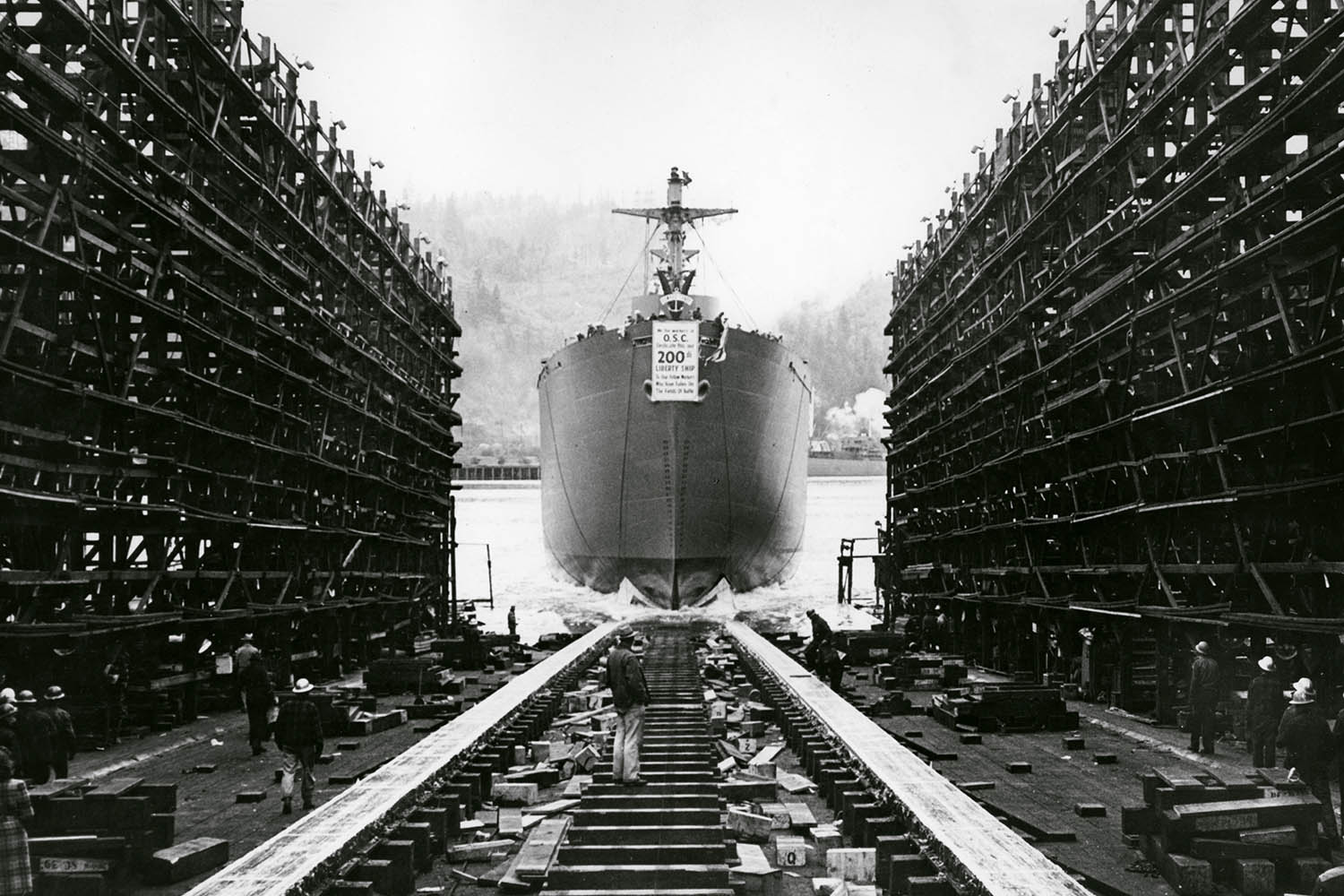
The nation needs publicly supported shipyards, which I propose calling “Liberty Yards,” echoing the successful maritime turnaround of the 1940s. The yards would be anchored in major maritime regions across the country and specialize in different vessel types. Public ownership provides what private capital cannot: long investment horizons and coordination across sectors such as education, finance, and manufacturing. Private contractors and foreign partners’ technology transfers would still be essential, but a foundation of public ownership would give the shipyards the staying power and long-term vision that private ownership cannot supply.
The Liberty Yards initiative would be paired with creating a maritime infrastructure bank to aggregate ship purchasing and operation across government and commercial buyers. Much like the existing Export-Import Bank of the United States or recent Department of Energy loan programs that provided early financing for Tesla, the bank would help by lending to buyers of U.S. vessels, stabilizing order pipelines, and reducing borrowing costs. The maritime infrastructure bank would offer the support that Asian competitors have long offered their shipbuilders through state-backed banks: namely, financial support and low-interest loans for builders, buyers, and operators to manage the high-risk and high-overhead business of maritime finance. Finally, a maritime workforce reserve program would help rebuild the labor base through competitive wages, structured training, and the creation of a standing reserve for surge production.

An employee at the Philly Shipyard waits to hear U.S. President Joe Biden make a campaign appearance in Philadelphia on July 20, 2023. Spencer Platt/Getty Images
The goal of the Liberty Yards proposal is not to overtake Chinese production, but rather to build enough to ensure national security and protect the economy if war or geopolitical threat caused other nations to recall their fleets. The Liberty Yards proposal seeks to expand the nation’s share of global shipbuilding modestly—from 0.1 percent to 1.5 percent within eight to 10 years.
This fifteenfold increase could become a source for stable, good-paying employment and produce much-needed ships. It could do so for approximately the same cost, over its first five years, as a single chip fabrication plant or one proposed Golden Fleet battleship.
Critics claim that the government should not own what private enterprise can produce. But this critique misinterprets history and misreads the international context. Every nation with a thriving commercial shipbuilding industry has nurtured and sustained it through state support. In China, nearly two-thirds of the ship tonnage built in 2021 came from government-owned yards. Beijing supports those yards even though they have operated at losses, generating negative 82 percent returns on government investments in shipbuilding. Strategic interests, not profits, guide nations’ support for maritime success.
In a moment when the United States has taken equity stakes in Intel and critical minerals producers, the Iran conflict makes the case that support for domestic shipbuilding is a national security priority. Iran’s effort to charge tolls for passage through the Strait of Hormuz underscores that the world can no longer take for granted free navigation of the seas. For large commercial shippers, the new choke points mean rerouting vessels and finding workarounds to redistribute costs.
But for U.S. strategic interests, a maritime world with more bottlenecks and adversaries creates foundational threats. Being at the mercy of foreign-crewed, foreign-flagged, and foreign-built vessels could threaten everything from access to jet fuel to medical supplies. Private capital won’t fix this. The absence of public commitment is what allowed the gap to open in the first place. Building a baseline of shipbuilding capacity can offset these risks by expanding the nation’s manufacturing resilience and protecting its military and commercial interests.
The shipbuilding industry did not have to die. Policymakers allowed it to collapse because the political consensus trusted the markets to sort everything out. The markets did their sorting, and China won. Reversing the decline will be expensive and time-consuming, but inaction—and the wrong actions—will cost even more.
Seen in that light, the question has less to do with whether the United States can afford to create public shipyards—it’s more about whether it can afford not to.

